Note: If you would like to use this resource, you are free to do so, but please reference me properly as your source. Thank you!
Abstract
This analysis offers a comprehensive exploration of the psychological archetypes and behavioral dynamics underlying the “yandere” character trope, a concept predominantly originating in fiction but reflective of extreme forms of obsessive and possessive behavior. It is important to emphasize that this work is not a professional psychological study nor grounded in empirical research; rather, it is a creative and analytical endeavor designed for entertainment, education, and to serve as a resource for writers, analysts, and enthusiasts.
The framework presented here draws on the intersection of narrative patterns, character psychology, and broader human behavioral studies, inspired by years of studying diverse fields such as criminology, psychology, and fictional narrative analysis. While the taxonomy and classifications are modeled after rigorous academic styles, they remain speculative and hypothetical, tailored for fictional application rather than real-world diagnostic or therapeutic purposes.
Readers are advised to approach this document as an interpretive guide rather than a scientific authority. The aim is to enrich creative storytelling and deepen understanding of the complex motives and expressions associated with obsessive character dynamics, providing nuanced insights for those crafting or studying fictional characters in media. This work also acknowledges the darker implications of these behaviors in real-world contexts, stressing the importance of ethical boundaries and responsible storytelling. As such, this analysis exists within a space of creative exploration, informed but not confined by academic methodologies, and seeks to foster discussion, engagement, and inspiration among its readers.
This is the detailed analysis classification for this post: How a Yandere Says, “I love you.” [GENERAL Library Classifications]. Feel free to use this research if you want, but please credit me appropriately. Thank you! And, please enjoy!
▃▃▃▃▃▃▃▃▃▃▃▃▃▃▃▃▃▃▃
- Abstract
- Preface
- ✅ Green Grass / Just Crazy
- 🏁 Protects You
- 💛 Respect Wife Juice
- 💛💛 Wholesome Creep
- 💛💛💛 Tempted To Kill
- 🍊 Jealous Like Jelly
- 🚩 “I love you.”
- 🚩🚩 Non-con Borders
- 🚩🚩🚩 “You’re mine.”
- 🏁 Actual Psychopath
- 🏴 Rapes Your Soul
- 🏴 Predator + Prey
- 🏴🏴 Mind Broken
- 🏴🏴 Torture + Body Horror
- 🏴🏴🏴 RUN NOW
- Recommendations / Sources / Citations
▃▃▃▃▃▃▃▃▃▃▃▃▃▃▃▃▃▃▃
Preface
Optional Links:
- How a Yandere Says, “I love you.” [GENERAL Library Classifications]
- How a Yandere Says, “I love you.” [GENERAL Library Classifications] (official website)
- Tumblr
- Male Yandere Recommendations [Incomplete Version]
- Male Yandere / Dark Romance Library {Complete Edition}
- Yandere Psychology: A Comprehensive Taxonomy of Obsessive and Possessive Love
═════════════════
The following info would contain the general work-in-progress research (or journaling) of male yandere classifications, especially of the black and red flags kind. Please take note of the following notes:
- This is my own PERSONAL classification guide, meant to help me in my library organization. It’s my own personal take on male yanderes and dark romance for fun, catered to my own tastes (dominant black flag sadists). And is subject to change, it’s not the final work.
- The main purpose of this is to CLASSIFY AND ORGANIZE MY LIBRARY. So, my tastes may not suit your tastes, and that’s fine, you can make your own classification or something. Go ham, bro.
- I wrote this a few months back just for fun and as a guide. So, it’s not fully updated yet. Furthermore, I only started adding yandere ratings and classifications around July to August 2024. Contrary to the 6 year old library I have.
- There will be a total of 15 Tiers. (20 if I’m pushing it), but in general 15 tiers.
- I will be releasing the full detailed analysis version when I’m not lazy or busy, lol. I also might release some more detailed reviews, pictures, etc. of my library for individual recommendations.
- For the detailed analysis of Yandere Types, I referred to : Yandere Town: Yandere Types. The detailed analysis one is extremely lengthy, so I have to think about whether to release it or not.
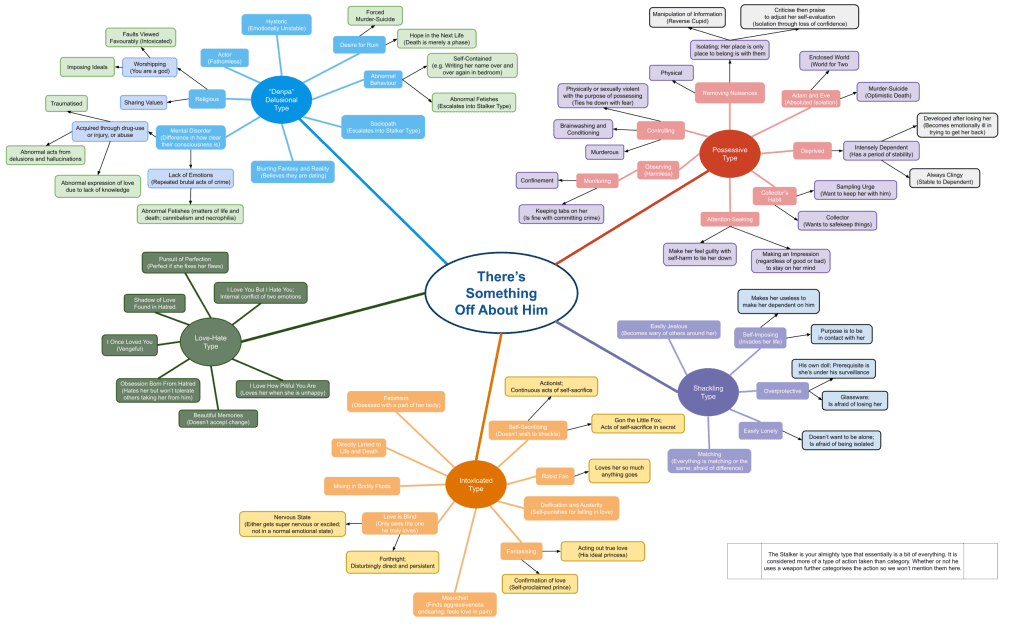
(this particular detailed analysis and image does not belong to me)
▃▃▃▃▃▃▃▃▃▃▃▃▃▃▃▃▃▃▃
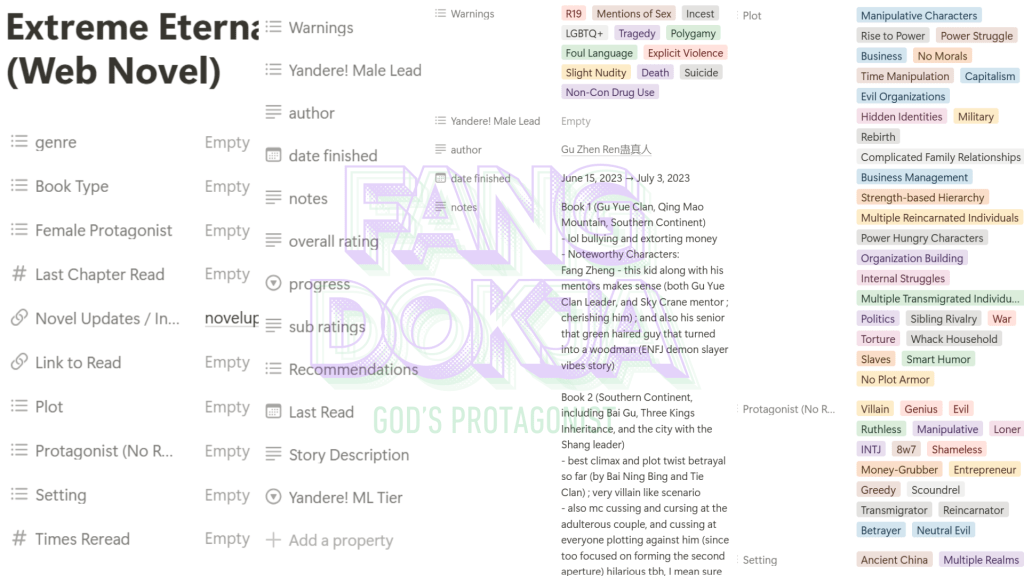
Sample Preview of the ‘Male Yandere Analysis’ Notion (Gallery View) ; banner images do not belong to me:

Sample Preview of the ‘Male Yandere Analysis’ Notion (Board View):
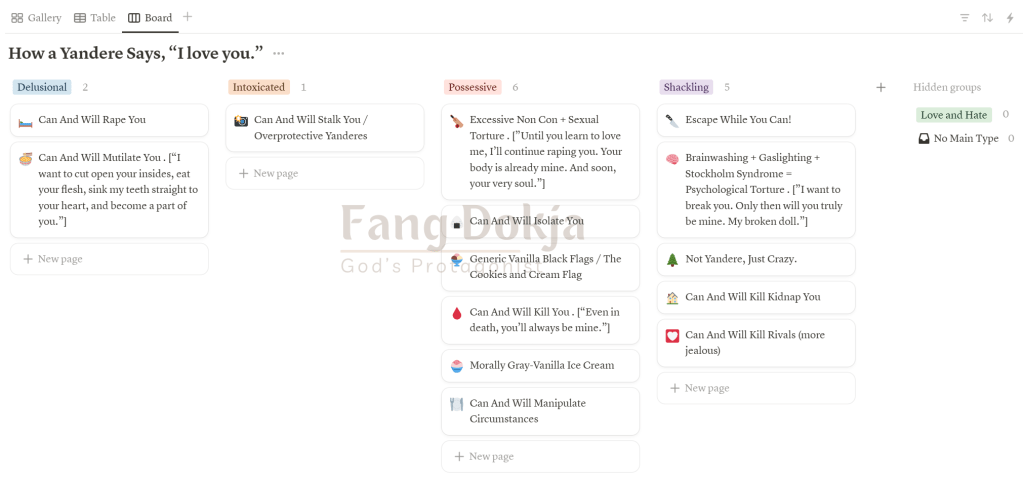
Sample Preview of the ‘Male Yandere Analysis’ Notion (Table View):

Sample Preview of ‘Zero-Triggers Library’:
═════════════════

Note: The percentages are just for show, an example. It is not statistically proven nor accurate. This graph is meant to just show the tier levels of the male yandere classifications.
▃▃▃▃▃▃▃▃▃▃▃▃▃▃▃▃▃▃▃
✅ Green Grass / Just Crazy
- Tier Number: 0
- Yandere! ML Tier: ✅ Green Grass / Just Crazy
- Name: Not Yandere, Just Crazy.
- Main Type: Shackling
═════════════════
General Research
Just Crazy.
═════════════════
Formal Extended Research
In Tier 0, “Green Grass / Just Crazy,” the yandere exhibits traits of obsession and fixation, but the motivation often diverges from romantic love, veering into areas of fear, control, and psychological instability. His attachment to the love interest may stem from an overwhelming fear of loss, manifesting in an almost timid and overly cautious demeanor. He views her as something fragile and precious, akin to delicate glassware, and approaches interactions with her as if any misstep might cause her to shatter. His primary concern is safeguarding her, though this protectiveness stems more from his own insecurities than from a selfless desire to nurture.
For some, this fear of loss is intertwined with an inability to be alone. Loneliness becomes an unbearable prospect, compelling him to shackle her to him emotionally or physically. This dependency drives him to ensure she remains by his side, even at the cost of her autonomy. Unlike yanderes who act out of desperation following a loss, he seeks to preempt such pain by creating circumstances where separation becomes impossible. His actions often escalate if he perceives any threat to their connection, though his initial approach may be veiled in an illusion of normalcy.
Another variant in this tier revolves around the pursuit of uniformity and psychological alignment. He may seek to replicate aspects of her identity or enforce a sense of matching, whether through appearance, preferences, or shared behaviors. This drive for symmetry is less about genuine connection and more about constructing a shared reality that isolates her from others. His fear of divergence is so pronounced that he cannot tolerate even minor differences between them, leading to controlling behaviors aimed at ensuring complete congruity.
In some cases, his fixation on her takes the form of idolization, where she is elevated to an idealized, almost divine status. However, this worship is conditional and brittle. He expects her to adhere to the standards he has constructed, and any deviation from this ideal provokes anger or disillusionment. For others, his focus is external, involving attempts to draw her into a shared belief system or ideology. His devotion to this external entity—be it religious or philosophical—competes with his attachment to her, resulting in efforts to mold her into compliance with his values.
Hatred and love intermingle for some yanderes in this tier, creating an obsessive dynamic where his fixation persists despite his animosity. This may emerge after a perceived betrayal, where intense love turns into equally intense hatred, yet his inability to let go binds him to her. Even in scenarios where he claims to despise her, the obsession remains intact, driving him to control or manipulate her life as a means of exerting power over his unresolved feelings.
A different kind of fixation arises when his attachment is not to her as a person but to specific aspects of her—her hair, voice, or physical traits. In such cases, his love is displaced onto these attributes, reducing her to an object of fetishistic focus. This fragmented attachment often results in behavior that seems detached from normal emotional relationships, as his attention remains narrowly fixated on the parts rather than the whole.
Yanderes in this tier may also be driven by a relentless desire to “perfect” her. While he admires much about her, he becomes fixated on certain perceived flaws and attempts to correct them, believing she can only be worthy of his love if she aligns with his vision of perfection. This behavior is not motivated by malice but by an inability to accept imperfection, leading him to impose changes on her life without regard for her wishes.
In essence, Tier 0 encapsulates a yandere who may not always operate out of traditional love but is invariably driven by an intense and unbalanced attachment. His actions are marked by a combination of fear, obsession, and a desire for control, which, while initially subtle, often escalate into more overt displays of psychological instability. His love, if present, is fractured, overshadowed by his own insecurities and compulsions, creating a dynamic that teeters between devotion and dysfunction.
Note: For my library, I also put the non-romance books in this section, because I was too lazy to make a new tier, and I hardly find Tier 0 characters anyway (that I actually like).
▃▃▃▃▃▃▃▃▃▃▃▃▃▃▃▃▃▃▃
🏁 Protects You
- Tier Number: 1
- Yandere! ML Tier: 🏁 Protects You
- Name: Morally Gray-Vanilla Ice Cream (Green Flags)
- Main Type: Possessive
═════════════════
General Research
Possessive Vanilla ML’s. Not yandere, just possessive (or a crazy serial killer).
Personality Types usually:
- MBTI: Can apply to anyone
- Enneagram: Can apply to anyone (but 8w7 and 7w8 are iffy at times)
═════════════════
Formal Extended Research
In Tier 1, “Protects You,” the yandere is at a foundational stage of fixation, displaying behaviors that are overwhelmingly rooted in genuine affection and an intense desire to ensure her safety and happiness. At this stage, his actions are driven by an emotional attachment that has not yet crossed into harmful or dangerous territory. Instead, his focus is on quietly observing her, often as a way to learn about her preferences, habits, and desires. His love, while intense, remains relatively benign and is characterized by an eagerness to protect and support her without imposing his will or violating her boundaries.
His observation of her may stem from an inquisitive nature, where he finds joy in simply understanding the details of her life. This can manifest in subtle ways, such as noticing her favorite books, recalling her casual remarks, or making mental notes about her routines. At this stage, these actions are not inherently intrusive but are instead reflective of his genuine care and thoughtfulness. However, his behavior hints at the potential for deeper obsession as he becomes increasingly focused on her presence and begins to prioritize her above all else.
For yanderes in this tier, the line between admiration and fixation is still intact. He may secretly watch her from afar, ensuring her well-being without interfering in her daily life. This passive form of protection is often motivated by a belief that his role is to remain a silent guardian, intervening only if necessary. His intentions are not malicious, and his actions are rarely disruptive, as his primary goal is to shield her from harm rather than control her. Despite this, his increasing preoccupation with her could lead to a gradual shift in his behavior, especially if his feelings deepen without reciprocation or validation.
Communication with her at this stage is often sincere and respectful. If he engages with her directly, his words and actions reflect a desire to build trust and connection without overwhelming her. This interaction may appear endearing or even charming, as his affection remains grounded in a sincere wish to be someone she can rely on. While his protective instincts are evident, they are expressed in ways that prioritize her comfort and happiness over his own desires.
This tier serves as a transitional phase for many yanderes, as their growing attachment and observation often lead to divergent paths. If his fixation intensifies, he may shift toward possessiveness or develop fantasies that distort his perception of their relationship. Alternatively, his protective tendencies could evolve into an overbearing need to control her surroundings, paving the way for more intrusive or manipulative behaviors. However, at this stage, he is not yet characterized by the darker traits associated with higher tiers, as his actions remain motivated by a pure, albeit intense, form of love.
The “Protects You” tier captures the complexity of a yandere who is still navigating the boundaries between devotion and obsession. While his love for her is undeniably profound, it has not yet consumed his identity or led to destructive tendencies. Instead, his role as a protector is rooted in genuine care and an unwavering commitment to her well-being. This fragile balance makes this tier uniquely stable yet precarious, as his feelings have the potential to evolve in unpredictable and transformative ways.
▃▃▃▃▃▃▃▃▃▃▃▃▃▃▃▃▃▃▃
💛 Respect Wife Juice
- Tier Number: 2
- Yandere! ML Tier: 💛 Respect Wife Juice
- Name: Can And Will Stalk You / Overprotective Yanderes (Yellow Flags)
- Main Type: Intoxicated
═════════════════
General Research
Yes, you can step on him, and he’ll thank you for it. No need to worry about your life being in danger. Sometimes they’re too shy or hesitant to approach you, not wanting to scary you or creep you out even more. Generally considerate, but they do love collecting trophies; as well as breaking into your home to touch you or take more pictures for their collection. But, generally harmless yanderes. The fact he won’t ever dream of harming a single hair on your head already says something about him.
And if he’s not a subby puppy yandere, then he’s just more possessive then Tier 1, and generally still wants you as his own but won’t cross too many lines. And of course, no harm comes to the darling— he’s the overprotective yandere with a slight possessive streak.
Personality Types usually:
- MBTI: Almost all feelers except INFJ (and can also exclude: ENFP, ISFP), No thinkers usually except INTP
- Enneagram: anything except 8w7 (and can also exclude: 7w6, 6w7, 6w5, 5w6, 7w8)
═════════════════
Formal Extended Research
In Tier 2, “Respect Wife Juice,” the yandere exhibits an overprotective devotion that borders on obsessive, with a profound fixation on preserving and controlling his perceived connection to her. This tier presents an intricate blend of behaviors, ranging from fervent dependence and self-sacrificial tendencies to disturbing manifestations of possession and worship. While his actions may not yet escalate to overt violence or malice, the underlying intensity of his love creates a suffocating dynamic that leaves little room for her autonomy. His existence is entwined with hers in ways that often blur the lines between affection and fixation, as his behavior becomes increasingly invasive or erratic.
In some cases, his dependence manifests as a profound response to loss, whether real or anticipated. If she distances herself, even temporarily, his world destabilizes, and his need to reunite with her consumes him entirely. This type of yandere often begins as seemingly mentally stable but experiences a rapid decline when faced with separation, leading to desperate actions. Conversely, his dependency may already be evident while they are together, revealing a clinginess that prioritizes keeping her close at all costs. In both variations, his emotional stability hinges entirely on her presence, leaving him unable to cope with the idea of losing her. This dependency often leads to obsessive behaviors aimed at maintaining their connection, whether through manipulation, pleading, or subtle coercion.
For others within this tier, his obsession takes the form of collecting or preserving elements of her existence. He may hoard items she has touched, such as clothing or discarded belongings, treating them as sacred relics that represent his bond with her. This fixation can escalate into darker expressions, such as a desire to immortalize her beauty in ways that disregard her agency. His artistic or imaginative tendencies might fuel his compulsion, but his actions ultimately stem from a possessive urge to claim her as his own, either physically or symbolically. This possessiveness can extend to disturbingly self-contained behaviors, where he isolates himself in his devotion, engaging in activities that range from innocuous fantasizing to unsettling rituals. While these actions may not directly harm her, their obsessive nature hints at the depth of his fixation and the potential danger of his unbalanced affection.
In other instances, his love for her transforms into a form of worship, where he views her as an infallible being deserving of unconditional adoration. His perception of her becomes so exalted that he interprets her every word and action as a divine truth, abandoning his judgment in favor of blind devotion. This reverence may have roots in a transformative moment he associates with fate or destiny, further reinforcing his belief in her perfection. While his intentions may seem pure, his deference to her elevates her to an unattainable pedestal, creating an emotionally one-sided relationship that places her under an immense burden of expectation.
A distinct subset within this tier displays behaviors stemming from acquired trauma or mental instability. His past experiences, such as childhood abuse or other psychological hardships, contribute to his inability to process emotions healthily. While he longs for her acceptance, his internal struggles often sabotage his efforts, leaving him trapped in a cycle of self-loathing and misplaced affection. This fragility positions him as a tragic figure whose obsession with her is both a coping mechanism and a symptom of his emotional scars.
Despite his overbearing tendencies, some yanderes in this tier express their love through acts of quiet devotion, seeking to protect or support her without demanding recognition. These individuals operate in secrecy, performing self-sacrificing gestures that, while ostensibly altruistic, often carry unsettling implications. His actions may include eliminating perceived threats to her happiness or intervening in ways she may never discover. While his intentions are not inherently malicious, his distorted sense of love can create situations that compromise her safety or freedom, even if indirectly.
Ultimately, Tier 2 yanderes represent a dangerous blend of overprotection, obsession, and idealization. While he may not yet resort to outright violence, his intense behaviors reveal a deep-seated inability to respect her independence or understand the boundaries of healthy affection. His fixation on her as the center of his universe not only isolates him from reality but also places her in a precarious position, where his love becomes both a shield and a cage. The subtle escalation of his actions foreshadows the potential for more destructive tendencies, as his unwavering devotion consumes his sense of self and clouds his understanding of her autonomy.
▃▃▃▃▃▃▃▃▃▃▃▃▃▃▃▃▃▃▃
💛💛 Wholesome Creep
- Tier Number: 3
- Yandere! ML Tier: 💛💛 Wholesome Creep
- Name: Can And Will Manipulate Circumstances (Yellow Flags)
- Main Type: Possessive
═════════════════
General Research
Will manipulate your circumstances (blackmail is still possible here and some dub con situations) and surroundings, even people, but won’t go as far as to hurt you. #ProtectDarlingSquad
Unlike the previous one, this yandere uses his intelligence more to manipulate the environment and people (even the darling, but not as badly as he treats others) to bring the darling closer to him and make the darling fall in love with him naturally and as peaceful as possible. Listen, intelligence and brain games makes everyone more dangerous yet thrilling.
Now when it comes to intelligence, the intelligence of the yandere has to at least make sense even for a bit, I’m not asking for ‘Reverend Insanity’ or even just ORV’s level of basicness or something; but I should at least not cringe so hard at the stupidity. Certain kinks can be an exception though, the yandere just has to love their darling after all.
═════════════════
Formal Extended Research
In Tier 3, “Wholesome Creep,” the possessive yandere begins to demonstrate a disturbing yet calculated intensity in his attachment, using manipulation and subtle coercion to entangle her within his influence. While he does not yet cross into overtly violent behavior, his actions reflect a deep-rooted need to control the circumstances surrounding her life. His obsessive tendencies become evident as he employs methods designed to tether her emotionally and physically, often under the guise of care or devotion. His behavior, while not outright threatening, exudes an unsettling quality that reveals his growing inability to separate genuine affection from the compulsive need to dominate her attention and environment.
One of the more troubling aspects of this tier is the use of self-harm as a mechanism for control. This yandere employs his own suffering as a means to elicit her pity or guilt, binding her to him through emotional manipulation rather than mutual affection. For him, pain becomes a tool—a visceral demonstration of his devotion or desperation. This form of attention-seeking is often impulsive, rooted in a misguided belief that her concern for his well-being will translate into deeper affection. His actions are rarely strategic; instead, they are driven by an overwhelming fear of losing her, leaving him with few tools beyond self-inflicted harm to maintain her proximity. This desperate behavior, however, often highlights his limited capacity to navigate relationships in a healthy or sustainable way.
Another defining feature is his tendency to monitor her life with obsessive precision. He may engage in behaviors that, while not overtly harmful, demonstrate a clear violation of her privacy. Secretly taking photos, bugging her devices, or tracking her movements are all methods he uses to keep tabs on her, ensuring that no aspect of her life escapes his notice. These actions are not driven by curiosity but by a possessive need to anticipate and control her decisions. Unlike more overtly violent yanderes, this tier’s methods remain covert, giving him the illusion of being a passive observer rather than an active manipulator. This meticulousness adds a sinister undertone to his devotion, as his desire to protect her transforms into a relentless need to know everything about her.
In some cases, this yandere seeks to integrate himself seamlessly into her life, often relying on her goodwill or affections to justify his presence. Financially dependent or emotionally needy, he positions himself as someone she feels compelled to care for, exploiting her nurturing tendencies to solidify his role in her life. His dependency is not born out of helplessness but out of a calculated effort to maintain proximity, ensuring that she cannot easily sever their bond without experiencing guilt or discomfort. While his presence may initially seem benign, it gradually becomes suffocating, as his underlying jealousy and possessiveness emerge in subtle but impactful ways.
Despite these controlling tendencies, there exists a self-sacrificial element to his behavior that complicates his character. His acts of devotion, while excessive, are often framed as expressions of pure love. Unlike yanderes in higher tiers, who seek to shackle her through force or fear, this tier prioritizes her happiness—even if it means enduring personal suffering. However, this devotion often carries a heavy undertone, as his love becomes a burden that she is unable to reciprocate fully without feeling overwhelmed. While he may not actively seek to harm her, his actions reveal an implicit expectation that she will recognize and reward his sacrifices, further entrenching her in his emotional grip.
Overall, Tier 3 reflects a complex and dangerous evolution in the yandere’s behavior. While his methods lack the overt violence or lethal intent seen in higher tiers, his actions remain deeply unsettling. His ability to manipulate circumstances and emotions, coupled with his obsessive tendencies, creates an environment where her autonomy is quietly eroded. For her, the relationship becomes a delicate balancing act, as his suffocating love veers ever closer to outright control. His ability to navigate the boundaries of affection and obsession without overtly crossing into harm makes him a uniquely insidious figure, his presence lingering like a shadow that cannot be easily escaped.
▃▃▃▃▃▃▃▃▃▃▃▃▃▃▃▃▃▃▃
💛💛💛 Tempted To Kill
- Tier Number: 4
- Yandere! ML Tier: 💛💛💛 Tempted To Kill
- Name: Can and Will Attempt To Murder (Yellow Flags)
- Main Type: Possessive
═════════════════
General Research
What’s different about this tier and the next one coming up is that this tier only has attempts on rivals’, people who get in the way of the relationship (protective kind especially), or general attempting to dispose of the competition and obstacles.
KEY WORD: “Attempt”
Whether they succeed or not (or even have the intentions to kill), they’re placed here regardless.
Think of this like the “dipping your toes” in murder kind of vibes. They may have a kill streak of 0-1 or at most 2 to protect darling regardless (it’s about protecting the darling and the relationship).
The next level tier level is for the more intense kind, like a higher kill streak.
A/N: Yeah I’m using kill streaks as a solid example so as to create a proper visual of things.
═════════════════
Formal Extended Research
In Tier 4, “Tempted To Kill,” the yandere’s possessive tendencies escalate into dangerous territory, marked by a volatile mix of obsession, aggression, and dependency. His actions often stem from an overwhelming need to ensure that she remains the focal point of his world, regardless of the cost to others or himself. This yandere operates in a space where the line between love and destruction blurs, as his possessiveness begins to manifest in actions that jeopardize the safety of those around her—or even herself. While he may not yet fully commit to violence, his impulses and behaviors strongly suggest a trajectory toward irreversible harm.
Attention-seeking is a defining feature of this tier. For the yandere, her recognition—whether positive or negative—is essential for his sense of identity. Even if her attention comes in the form of fear or hatred, he perceives this as preferable to being ignored. This desperation often drives him to provoke her or engage in actions she explicitly dislikes, as long as it ensures he occupies space in her thoughts. The most dangerous aspect of this need for attention is its volatility. When his efforts fail to elicit the reaction he craves, his frustration can lead to increasingly erratic or aggressive actions, escalating his fixation on asserting his presence in her life.
The dependence of this yandere on her existence adds another layer of instability. His identity and purpose are entirely entwined with her presence, making her the sole anchor in his otherwise hollow existence. Should she disappear—whether by distancing herself or through unforeseen circumstances—his entire sense of meaning collapses. This can lead to extreme responses, such as self-destruction or violent outbursts against perceived obstacles to their bond. Unlike yanderes who fight to maintain control for dominance or satisfaction, this tier’s actions are motivated by the fear of losing his only source of emotional sustenance.
When removing perceived nuisances, this yandere’s methods range from petty interference to dangerous sabotage. He may undermine her relationships or manipulate others to sever ties with her, but his lack of subtlety often exposes his intentions. His impulsive nature makes him less calculating than yanderes in higher tiers; instead, his short temper and lack of foresight lead him to act rashly, often leaving behind evidence of his interference. For example, he might physically harm a rival or disrupt her social circle in clumsy, obvious ways, drawing attention to his obsessive behavior. His lack of sophistication in executing these schemes only amplifies his perceived threat, as his unpredictability becomes a key factor in the danger he poses.
This tier also reflects a growing overlap between emotional instability and physical danger. Unlike yanderes in lower tiers, where possessiveness is primarily emotional or psychological, this tier introduces the tangible threat of harm. Though his actions may still fall short of outright murder, they frequently flirt with the boundary, creating an environment of tension and fear for anyone involved in her life. This progression distinguishes him from those in more extreme tiers, where violence becomes a defining characteristic, but it also places him well beyond the realm of benign obsession.
Ultimately, the Tier 4 yandere is a deeply troubled figure whose love is inseparable from his destructive impulses. His behavior reveals the cracks in his psyche, where his yearning for connection and validation transforms into a dangerous compulsion. For her, navigating his volatile moods and increasingly intrusive actions becomes a harrowing ordeal, as his fixation grows more suffocating and his willingness to harm others—or himself—escalates. While his violence may remain constrained by hesitation or incompetence, his intentions and emotional state make him a significant threat, teetering on the edge of irrevocable actions that could forever alter her life.
▃▃▃▃▃▃▃▃▃▃▃▃▃▃▃▃▃▃▃
🍊 Jealous Like Jelly
- Tier Number: 5
- Yandere! ML Tier: 🍊 Jealous Like Jelly
- Name: Congrats! Serial Killer In The Making (Orange Flags)
- Main Type: Shackling
═════════════════
General Research
Yeah, he kills people, but at least he won’t kill you… right? Usually this applies to rivals or friends, very rarely will one write killing family because of jealousy for family bonds.
Of course, any yandere would get rid of rivals. But, at this Tier, the yandere has a noticeable kill streak, preferably not just less than 10 people. With intentions to get rid of romantic (usually) rivals only; not simply to protect the darling from danger, because that would fall under the lower Tiers instead. They’re actual killers with blood on their hands, blood spilled not for their individual goals outside of their darling, but actual intentions to get rid of competition completely.
Of course, other yanderes may not necessarily spill blood to get rid of rivals. But the first one is preferred (not just logically), but also to solidify the place in the Tier level. Manipulation and other ways to get rid of rivals can be included (and sometimes it’s not explicitly stated in text to show it, so dig deeper then), but just make sure that you can tell the difference between overprotective yanderes and possessive yanderes.
When pushed to the absolute brink, they can double suicide with you, but it takes a lot of effort to do that, as anything below red flags won’t cause the yandere to seriously harm you, or give you a permanent scar psychologically and especially physically. However, for the suicide case, I won’t consider it in the ‘Murder Black Flag Vibes’ (even red flag) because these yanderes are generally harmless unless a direct threat comes to threaten the darling’s life (or at times, the relationship between the yandere and darling). And even then, rarely will they even think (much less commit) to kill the darling. They’re obsessive and intoxicated that way.
A/N: This isn’t thrilling enough for me, it’s why I don’t vibe with anything below Red Flags, unless I’m not reading for romance. But, what majorly separates Yellow Flags, Orange Flags, Green Flags, etc. (other colors in general aside from black flags) from Red Flags is if they’re willing to hurt the darling, these types of yanderes won’t.
═════════════════
Formal Extended Research
Tier 5, “Jealous Like Jelly,” describes a yandere who is deeply consumed by envy and suspicion, with jealousy forming the central pillar of his obsessive attachment. His intense aversion to her interactions with others, whether platonic or otherwise, signifies an overbearing need for exclusivity in her attention and affection. This behavior, though common among possessive yanderes, takes on a pronounced intensity in this tier, marking the beginning stages of potentially dangerous actions. While not inherently violent or malicious, his inability to process his emotions rationally often sets the stage for future escalation, where jealousy can spiral into unhealthy possessiveness and erratic behaviors.
The yandere’s jealousy manifests in a range of ways, from subtle unease to outright hostility. If she speaks to or interacts with others, even in innocuous contexts, he may perceive these encounters as threats to their bond, fueling a cycle of suspicion and insecurity. His emotional state is fragile, and his responses are often disproportionate to the situation at hand. For instance, he might express annoyance or act withdrawn when he sees her speaking casually with someone else, even if no romantic intent is present. Over time, this can lead to obsessive monitoring or attempts to subtly manipulate her social environment, such as discouraging her from meeting certain people or attending events.
The degree of his jealousy directly correlates to his mental stability. In its milder forms, his behavior may appear as harmless overprotectiveness, but as his jealousy deepens, it highlights underlying emotional instability. Yanderes in this tier often fail to distinguish between their subjective fears and objective reality. This inability to manage jealousy healthily not only disrupts the relationship but can also isolate her from others as his controlling tendencies grow. The more his emotions surpass jealousy into irrational fixation, the more he becomes a potential danger to her and those around her. However, at this tier, his actions are primarily emotional rather than physical, keeping his behavior distinct from the more extreme forms of possessiveness seen in higher tiers.
The early signs of this yandere’s instability are subtle but telling. He might become restless when left alone, overthink innocuous scenarios, or even exhibit minor passive-aggressive behaviors when she interacts with others. Though these tendencies might initially be dismissed as quirks or protective instincts, they gradually evolve into more apparent disruptions. For instance, if he perceives her spending time with others as a slight against their relationship, his responses may range from sulking to subtly guilt-tripping her into prioritizing him. While his feelings of jealousy often stem from insecurity, they are also an early indicator of his inability to regulate emotions or establish boundaries, making him a complicated and potentially volatile presence in her life.
This tier notably separates itself from higher levels of possessiveness by the absence of outright violence or malicious intent. Unlike more dangerous yanderes, who resort to physical harm or extreme manipulation, the Tier 5 yandere operates within an emotional framework. His jealousy, though overwhelming, is not inherently sadistic or destructive. Instead, it reflects his struggle to reconcile his intense feelings with his need for her validation and loyalty. However, if left unchecked, his unchecked insecurities and emotional instability may eventually lead to more overtly harmful behaviors, bridging the gap to more severe manifestations of yandere tendencies.
In contrast to those with severe emotional abnormalities, such as sociopathic yanderes or those entirely detached from reality, the Tier 5 yandere’s jealousy is a uniquely human trait. His intense emotions stem from his perception of her as central to his existence, yet his lack of healthy coping mechanisms transforms this into an obsessive vulnerability. His inability to view her interactions with others in a neutral light sets the tone for a relationship steeped in mistrust and emotional manipulation. For her, navigating his volatile jealousy becomes an exhausting task, often leaving her caught between his need for reassurance and her own dwindling autonomy.
▃▃▃▃▃▃▃▃▃▃▃▃▃▃▃▃▃▃▃
🚩 “I love you.”
- Tier Number: 6
- Yandere! ML Tier: 🚩 “I love you.”
- Name: Can And Will Kill Kidnap You
- Main Type: Shackling
═════════════════
General Research
Personality Types usually:
- MBTI: Can apply to almost all feelers (INFJ being most applicable); but most applicable to all thinkers, except INTP
- Enneagram: usually 8w7, 7w8, 5w4, 5w6
Most supposed yanderes people classify as “red” or even “black” flags actually fall under this category. They’re canonically crazy (the ones people say this to: “Go to therapy.”) whether actual serial killers or callous people in power, who can and will use people to their advantage and goals.
In reality, what differentiates Red Flag Yanderes most from Black Flag Yanderes would be their internal want (and even need) to make the darling love them (whether they outwardly admit it or not). They’re much more patient with this because of the required intelligence to be a Red Flag, and they’re still kind enough to the darling. Yes, they bully and make the darling considerably suffer, but they still want to be loved by the darling so there are still moments of affection with them to court the darling, as their usual end goal is to be loved by the darling (not a relationship to be despised by the darling)— and not to simply possess the darling.
═════════════════
Formal Extended Research
Tier 6, “I Love You,” represents a yandere whose actions revolve around containment, control, and fostering an unhealthy dependence within the relationship. This tier’s defining feature is the act of confinement, where the yandere physically isolates her, ensuring she remains within his reach and far from external interference. The yandere’s primary objective is to maintain constant supervision over her, creating an environment where her autonomy is restricted and her movements are entirely dictated by his will. This dynamic often results in her gradual loss of independence as she becomes increasingly reliant on him for her basic needs and emotional stability.
A crucial aspect of this behavior is the yandere’s ability to plan and execute such confinement effectively. Financial stability or access to a hidden location is typically necessary to sustain such a situation. His ability to adapt and anticipate challenges is indicative of his obsessive dedication. While his actions stem from an intense desire to protect and preserve his connection with her, they also highlight his belief that her freedom poses a threat to their bond. The nature of this confinement varies, but it always emphasizes control and dependency, leading to an unhealthy and restrictive relationship dynamic.
The yandere’s approach to fostering dependency often blurs the line between care and manipulation. He may present himself as a self-sacrificing figure, taking care of her every need and ensuring she feels safe and cared for. However, this caregiving is not born of altruism but of a calculated effort to make her rely on him entirely. Over time, she may find herself unable to function independently, her sense of agency eroded by his overbearing presence. The yandere’s ultimate goal is to create a situation where their relationship becomes mutually dependent, though the imbalance of power ensures that he retains control.
In some cases, this possessive behavior is rooted in a deep misunderstanding of love. A lack of nurturing during childhood or exposure to dysfunctional relationships can lead the yandere to develop an incomplete or distorted understanding of affection. This can manifest as an instinctive, almost primal need to act on his emotions without fully grasping the consequences of his actions. His inability to distinguish between genuine care and harmful control creates a relationship dynamic that, while devoid of malicious intent, is inherently damaging to both parties. Over time, he may begin to recognize the abnormality of his behavior, which can lead to inner conflict and emotional turmoil, though this realization rarely translates into meaningful change without external intervention.
Despite his restrictive tendencies, the yandere may exhibit behaviors that reflect a genuine concern for her well-being. His actions often stem from a deep-seated fear of losing her or of her coming to harm, which paradoxically leads him to adopt methods that ultimately stifle her sense of self. His overprotectiveness, while seemingly kind, is underscored by an inability to trust her to navigate the world independently. This leads to behaviors such as infantilization or obsessive monitoring, ensuring that she remains within the confines of his constructed reality.
Tier 6 yanderes differ significantly from those in higher tiers, as their actions are often fueled by emotional dependence rather than malice or sadism. Unlike the extreme violence and psychological torment seen in Tier 10, the yandere in Tier 6 seeks to protect and confine rather than to inflict suffering. However, the impact on the darling remains severe, as her autonomy, individuality, and ability to escape the situation are systematically eroded. His possessive love is suffocating, leaving her trapped in a relationship defined by restriction and control rather than mutual respect and trust.
▃▃▃▃▃▃▃▃▃▃▃▃▃▃▃▃▃▃▃
🚩🚩 Non-con Borders
- Tier Number: 7
- Yandere! ML Tier: 🚩🚩 Non-con Borders
- Name: Can And Will Rape You
- Main Type: Delusional
═════════════════
General Research
Baby trapping, impregnation and almost all kinds of non-con kinks (and of course, all dub-con) are included here.
Note: The difference of the red flag yandere with the black flag yandere in the categories I placed here is that red flag yanderes won’t continue to rape the darling, or the darling usually falls for the yandere later on. It’s more of at the start of the relationship usually, or when something triggers the jealousy of the yandere.
Black flag yanderes don’t give a shiz about consent at all. It’s not about love after all, it’s about control. Even if the darling hates them, they don’t give a shiz and could care less about the emotions and mental health of the darling (especially if it’s not the generic vanilla black flag yanderes, since vanilla black flags are kinder to the darling).
Red flag yanderes still want and prioritize the love of the darling above all, even if they don’t get it straight away. Non con actions of red flag yanderes usually are motivated as more of a process to get love, babytrap, or trick the darling.
═════════════════
Formal Extended Research
Tier 7, “Non-Con Borders,” represents a yandere whose behavior is a troubling amalgamation of possessive delusions and unstable control. At this tier, his actions are driven by a profound disconnection from reality, a skewed understanding of love, and a desperation to solidify his claim over her. What sets this tier apart is its dangerous volatility. The yandere may employ physical violence or coercion, not as a calculated strategy but as an instinctive reaction to his emotional instability. His pursuit of her often results in non-consensual acts that he rationalizes as necessary to preserve their bond, all while being oblivious to the damage he inflicts. This tier is marked by the inability to fully separate fantasy from reality, leading to increasingly erratic and harmful behavior.
Unlike higher tiers where sadism or intentional torture dominates, Tier 7 is less about inflicting pain for pleasure and more about the loss of self-control and delusional rationalizations of his actions. His violence is impulsive, stemming from frustration, fear of abandonment, or his inability to manage intense emotions. In moments of clarity, he may experience regret or shame, which briefly tempers his behavior before his delusions resurface. These moments of remorse are a key differentiator between Tier 7 and the more extreme Tier 10, where intentional, prolonged physical and psychological torture dominate, often for the sadistic pleasure of watching her suffer.
Emotionally unstable and hysteric traits may emerge, making him prone to drastic mood swings and panic attacks. His fear of losing her can manifest in aggressive outbursts, and his emotional volatility can escalate the danger for her. For instance, rejection or perceived dishonesty might provoke an unpredictable response, such as physical restraint, forced intimacy, or verbal degradation. He views her as the key to his emotional stability, and any threat to that belief sends him spiraling into erratic behavior. Unlike Tier 10, where psychological or physical torture is premeditated and relentless, Tier 7’s actions are reactive, stemming from his internal chaos rather than a calculated desire to inflict suffering.
Adding complexity to this tier, some yanderes may blur fantasy and reality to the extent that they misconstrue her rejection or fear as signs of affection. This disconnection makes reasoning with him nearly impossible, as he filters all interactions through his warped perception. His delusions protect him from fully comprehending her perspective, rendering her attempts to escape or appeal to his humanity largely futile. In some cases, these delusions are exacerbated by acquired mental disorders, such as drug-induced psychosis or trauma-induced hallucinations, further eroding his grip on reality and amplifying the danger he poses.
Certain subtypes within this tier are shaped by nostalgic fixation. These yanderes idealize a specific version of her, unable to tolerate any deviation from their perceived “perfect” state. Should she change—whether through personal growth or physical aging—he may become fixated on preserving or recreating that past version of her, resorting to control or violence to enforce his ideals. This obsessive clinging to a nostalgic memory can lead to her harm if he perceives her transformation as a betrayal of his fantasy.
While Tier 7 is undeniably perilous, it lacks the calculated malice and devastating intent of Tier 10. The latter involves extreme, often sadistic behaviors designed to inflict lasting physical or psychological trauma, with no regard for her survival or well-being. In contrast, Tier 7 yanderes are defined by their chaotic, emotionally charged reactions and a lingering—albeit distorted—desire for connection and validation. They harm her not to destroy her, but to reinforce their fragile delusions, making them dangerous but fundamentally distinct from the deliberate and torturous cruelty of higher tiers. The hallmark of Tier 7 is its instability: unpredictable, emotionally driven actions that arise from an intense but deeply flawed obsession.
────────────
Differences between Tier 7 and Tier 10 Yanderes
Tier 7, “Non-Con Borders,” embodies a yandere who is dangerously delusional and sees no moral or ethical boundaries in his pursuit of physical intimacy with his beloved. While deeply unsettling, this tier differs from the more severe Tier 10, “Rapes Your Soul,” as the focus in Tier 7 lies predominantly on the violation of consent rather than the extreme physical and psychological torture that defines higher tiers. Here, the yandere’s actions stem from an obsessive belief that his love justifies any means to claim her, even at the expense of her autonomy and well-being. His perception of love is warped, leading him to force intimacy under the delusion that it will solidify their connection.
Unlike the calculated or controlled manipulation seen in other possessive tiers, Tier 7 yanderes act impulsively, often justifying their behavior as a means of expressing their affection. Their lack of regard for consent underscores an inability to empathize with her perspective or emotional state. The violation in this tier, while severe and psychologically damaging, does not cross into the extreme realms of physical torture or high-risk, life-threatening behaviors characteristic of Tier 10. Tier 7’s violations may leave profound emotional scars, but they stop short of the sadistic edge play, mutilation, or deliberate physical trauma seen in the higher tier.
Tier 10, by contrast, takes the violation to an entirely different level. This higher tier involves deliberate and often premeditated acts of extreme physical and psychological torment, where pain, humiliation, and trauma are integral to the yandere’s expression of control. For instance, Tier 10 might involve sadistic practices such as branding, choking to the point of unconsciousness, or the use of weaponry in “edge play,” all of which can result in severe injuries, disfigurement, or even death. Psychological torture in Tier 10 is equally severe, with the yandere employing methods designed to shatter her sense of self entirely, leaving her emotionally and mentally fragmented. The cruelty here is not incidental but intentional, with the pain inflicted serving as a perverse assertion of dominance.
In contrast, Tier 7 lacks the calculated sadism of Tier 10. A Tier 7 yandere might force intimacy in the misguided belief that such actions will lead her to reciprocate his feelings. He may coerce her into compliance through emotional manipulation or physical restraint, but his goal is not to inflict pain for its own sake. While his actions can result in psychological trauma and feelings of helplessness, they are not laced with the overt malice or sadistic pleasure that define Tier 10’s harrowing acts.
An example of Tier 7 behavior could include cornering the beloved and forcing intimacy despite her clear resistance, interpreting her protests as a temporary barrier to be overcome rather than genuine rejection. His delusion blinds him to the reality of her suffering, as he sees his actions as an expression of love rather than a violation. By contrast, a Tier 10 yandere would escalate such a situation into a deliberate act of prolonged torture, introducing elements of fear, humiliation, or physical harm that go far beyond the violation of consent.
The distinction between these two tiers lies in the intent, scale, and extremity of their actions. While Tier 7 is characterized by a dangerous delusion that disregards boundaries and consent, Tier 10 represents a level of cruelty and sadism that not only violates but seeks to destroy. Tier 7 is horrific in its disregard for autonomy, but Tier 10 is far worse, delving into realms of pain and trauma that leave no aspect of the beloved untouched, physically or psychologically. This critical difference underscores the progressive severity within the yandere spectrum, where obsession takes on increasingly destructive forms.
▃▃▃▃▃▃▃▃▃▃▃▃▃▃▃▃▃▃▃
🚩🚩🚩 “You’re mine.”
- Tier Number: 8
- Yandere! ML Tier: 🚩🚩🚩 “You’re mine.”
- Name: Can And Will Isolate You
- Main Type: Possessive
═════════════════
General Research
“No one else, but me.”
Why is this higher than non-con? Simple. Because if you actually experience what it means to be isolated for years (yes, even if you dislike people and are a loner), it drives majority of people crazy. No form of human contact, just alone with your thoughts (worse if you’re an overthinker or have mental illnesses). It’s a trial only few could conquer, because you really have to rely on yourself usually— all on your lonesome. When it’s isolation, it’s real isolation. No one else, but the yandere and darling together, forever and always.
═════════════════
Formal Extended Research
Tier 8, “You’re Mine,” represents a possessive yandere driven by the compulsion to isolate his beloved from the external world. The primary objective of this tier is to create an environment of mutual dependency, where he becomes the sole source of emotional, social, and psychological support for her. This yandere’s methods are calculated and exploit a deep understanding of her personality, wielding manipulation to sever her connections with others while gradually eroding her sense of self-worth. Unlike more aggressive or overtly destructive tiers, his approach is insidious, often cloaked in what might initially appear to be care or concern, but which ultimately reshapes her reality to revolve entirely around him.
Isolation is carried out with precision, targeting relationships and connections that he perceives as threats to his exclusivity. He may criticize her subtly, chipping away at her confidence by emphasizing perceived flaws or failures, only to follow these moments of denigration with excessive praise or affection when they are alone. This push-and-pull dynamic reinforces her emotional dependency, as she begins to seek his approval as a means of regaining her lost sense of value. Over time, this cyclical behavior cultivates a toxic environment where she becomes hyperaware of his reactions, molding her actions and thoughts to avoid his disapproval.
The isolation is not merely about removing external influences but also about reshaping her perception of herself and her relationships. By controlling the narrative around her worth and interactions, he ensures that her identity becomes tethered to his presence. This transformation is gradual, with his actions tailored to her specific vulnerabilities, making it difficult for her to recognize the manipulation. Unlike tiers focused on total control or destruction, Tier 8 yanderes aim to achieve a state of dependence that, while stifling, does not render her entirely non-functional. Instead, her world becomes smaller and more restricted, with him at the center.
Examples of this behavior might include a yandere who discourages her from spending time with friends or family, subtly sowing doubt about their intentions or loyalty. He may express concern over their influence, framing his actions as protective rather than possessive. When she inevitably pulls away from these relationships, he showers her with affection, reinforcing the notion that he is the only person who truly cares for or understands her. Over time, she becomes isolated not through overt coercion but through the gradual erosion of her external connections and self-confidence, leaving her entirely reliant on him for emotional support.
This tier, while less overtly destructive than higher levels, poses a profound danger to the beloved’s autonomy and sense of self. The focus on mutual dependency distinguishes it from tiers where the yandere seeks to exert complete dominance or break the beloved’s mind. Here, the goal is not to render her powerless but to create a dynamic where she cannot imagine life without him, effectively tethering her identity and existence to his presence. This tier is a chilling reminder of the subtlety with which manipulation and isolation can strip away individuality, leaving the beloved trapped in a cycle of dependency disguised as devotion.
────────────
Differences between Tier 6 and Tier 8 Yanderes
The distinction between Tier 6 Kidnapping Yanderes and Tier 8 Isolating Yanderes lies in the methods and underlying motivations of control they impose on their beloved. Tier 6 yanderes, characterized by their immediate and physical approach to possession, are akin to shackles. They prioritize tangible restraint, removing the female darling from her existing environment entirely. Their actions are driven by an urgent need to keep her close, often employing abduction as a desperate act of love. For them, physical presence equates to security, and the act of kidnapping represents their belief that proximity can prevent any external threats or temptations from stealing her away. These yanderes often display raw, emotional volatility, as the act of confinement stems from impulsivity, fear, and an overwhelming desire to safeguard their fragile sense of connection.
In contrast, Tier 8 yanderes take a more strategic and psychologically insidious approach, resembling a metaphorical cage. Their aim is not solely physical captivity but to create an environment so isolating that the darling cannot conceive of leaving. Instead of acting on desperation, these yanderes methodically dismantle her social support system, sever ties with friends and family, and subtly manipulate circumstances to make her world revolve solely around them. Their methods are patient, calculated, and designed to foster emotional dependence. While Tier 6 focuses on physical control to ensure compliance, Tier 8 targets the darling’s psyche, reinforcing the belief that she is safe, loved, and understood only within the confines of the relationship. This emotional entrapment is often harder to identify, as it masquerades as care and protection, but its effects are far-reaching and enduring.
A Tier 6 yandere might exemplify his nature by forcibly abducting the darling from a perceived threat, such as a romantic rival or a decision that risks creating distance between them. He might keep her locked in a secluded location, believing that his sheer physical presence can preserve the relationship. In contrast, a Tier 8 yandere may gradually manipulate the darling’s environment to make her feel alienated from anyone but him. He might sabotage her friendships, intercept communications, or guilt her into believing that others are untrustworthy or even harmful. This psychological cage ensures that even if she has the means to leave, her dependence on him makes her feel unable to do so.
Ultimately, the difference lies in the immediacy of the methods and the focus of control. Shackles bind the body, while a cage confines the mind. Both forms of obsession demonstrate profound possessiveness, but the strategies they employ reflect different levels of patience, psychological depth, and manipulation, making the experiences distinct yet equally consuming.
▃▃▃▃▃▃▃▃▃▃▃▃▃▃▃▃▃▃▃
🏁 Actual Psychopath
- Tier Number: 9
- Yandere! ML Tier: 🏁 Actual Psychopath
- Name: Generic Vanilla Black Flags / The Cookies and Cream Flag
- Main Type: Possessive
═════════════════
General Research
In this category, most ‘toxic’, ‘dark’, or whatever people say, are just generic vanilla black or even red flags. To me, that’s nothing. Just vanilla shiz. Sometimes, it’s even just Vanilla BDSM. That’s worse! (my expectations dead) No horror elements, or even thriller worthy memories at the moment. Others get scared, but it’s stupid to me.
Especially with this fact: There is no true danger to the life of the darling. I mean, I guess it happens a lot in fiction in general. But still. It sucks if there’s no true danger, no true handing another’s very life to another. Because I can already tell there is no ‘true hurt’, it’s more of, ‘it hurts now, but you can handle it’. It’s not the, ‘I can and will kill you.’ kind of danger. Yeah, yanderes or red and even most “black flags” won’t go that far. But to me, then there’s really no need to worry at all. Darling won’t really die, because the yandere won’t actually kill her. It’s just all part of the fun. Or an initial process even.
Think of it like the equivalent of plot armor in shounen anime.
Boring. Real thrill comes when your very life is in danger, like you could actually die. It’s where the author isn’t afraid to kill off the beloved darling or even the yandere for a good story and plot. This is just a me thing, but true romance can come from horror, where it’s so intimate to place your very life in another’s hands.
But, like all black (or even some red) flags, they all want control. It’s just a question now, on how far are they willing to go to gain it.
Black Flag Basic & General Info
Black flags are the most selfish yanderes, and usually the most dominant ones.
Will make me believe what he’s doing is right and just. If he’s really good. Then I would even thank him for torturing me and ruining my life because Stockholm Syndrome kicks in, and all kinds of gaslighting techniques. Either way, he loves me, and I love him. So, it’s a happy ending for everyone (well except for everyone else who got tortured and died, but he doesn’t let you know that, just focus on him).
Unlike all previous tiers, all Black Flag yanderes rarely care if the darling loves him. To him, it’s about possession and domination, to get the darling, treating the darling like property (or worse, a slave, whether willing or unwilling). Love is an added bonus and one of the top tier goals, but it’s not the initial goal in the start of the relationship. It’s about gaining the darling, no matter the cost.
Personalities Types usually:
- MBTI: ENTJ, ISTP, INFJ (can also include: INTJ)
- Enneagram: 8w7 (can also include: 7w8)
A/N #1: Some stories may be rated with a 🏴, instead of simply a 🚩 despite the way the plot developed. Some people don’t notice it, even writers themselves; but there is actual questionable manipulation, despite no explicit statements. And that’s what makes it borderline disturbing.
A/N #2: Unfortunately, even ‘Try Begging’ is just vanilla BDSM for me. So far, none have topped ‘Who is the Prey’ (in manhwa or web novels) in terms of black flag male leads, especially since this has more psychological warfare. It’s not just about rape, physical violence, etc., play smart about it and brainwash the darling to love it (100% if possible). I mentioned this, because a lot of the black flag ML’s here are the ‘generic black flag ML’s’. To me, it’s not even scratching the actual experience of a black flag yandere, it’s just vanilla ice cream to me right now. But since I can’t find actual decent black flag yanderes ANYWHERE except one source, than I didn’t bother changing classifications right now. It’s meant to be a library arrangement anyway.
═════════════════
Differences Between Tier 9 and Tier 12 Yanderes
Tier 9, known as “Actual Psychopath,” represents a calculated and methodical approach to obsessive possession. This yandere operates with an air of meticulous control, aiming to dominate the beloved completely through psychological manipulation, brainwashing, and conditioning. Unlike the chaotic emotional instability seen in higher tiers, such as Tier 12’s “Mind Broken,” Tier 9 yanderes are defined by their rational, detached strategies and the deliberate erosion of their victim’s autonomy and individuality. Their methods reflect a clinical, almost mechanical perspective on domination, rooted in a desire to mold the beloved into an obedient and subservient figure rather than a partner in a reciprocal relationship.
The hallmark of this tier lies in the use of punishment, manipulation, and reconditioning to reshape the beloved’s personality. The yandere’s actions are not borne from emotional volatility but from a cold, logical pursuit of power and possession. He may present himself as an authoritative figure, enforcing compliance through calculated measures that gradually strip her of her independence and reshape her identity to align with his desires. The goal is not to elevate or improve her but to reduce her to a state of regression, where her only role is to serve as an extension of his will. This psychological control often leads to significant changes in her behavior and personality over time, transforming her into a shadow of her former self.
What differentiates Tier 9 from Tier 12 is the nature of the psychological impact. In Tier 12, the victim’s mind is completely broken, leaving her fragmented, mentally shattered, and often incapable of coherent resistance or self-recognition. The yandere in Tier 12 thrives on this total destruction of the beloved’s psyche, deriving satisfaction from her helpless state. By contrast, Tier 9 yanderes do not necessarily seek to destroy the beloved’s mind outright; instead, they aim to reshape and control it. The process is systematic rather than chaotic, with the ultimate goal being her subservience rather than her obliteration. This distinction underscores a chilling pragmatism in Tier 9, where the yandere’s tactics are carefully calibrated to ensure the victim remains functional enough to fulfill his vision of a controlled, obedient companion.
In some cases, the yandere in Tier 9 may even grieve the transformation he has wrought, lamenting the loss of the vibrant personality that first drew him to her. Alternatively, he may remain oblivious to the changes, viewing her altered state as the natural result of his “guidance” and conditioning. Both reactions reveal the fundamental disconnect between the yandere’s perception of love and the reality of his actions, as his obsession blinds him to the harm he inflicts.
An example of a Tier 9 yandere might involve a man who employs subtle manipulation to isolate the beloved from her support systems, undermining her confidence and instilling dependence on him. Over time, he conditions her responses to align with his expectations, using rewards and punishments to reinforce his control. Her gradual transformation into a compliant, docile figure is not the result of emotional breakdown but the calculated outcome of his sustained efforts to dominate her mind and spirit.
Tier 9 reflects the chilling capacity of controlled obsession to methodically dismantle a person’s identity without the overt chaos or brutality seen in higher tiers. The emphasis on psychological manipulation and calculated control, combined with the deliberate nature of the yandere’s actions, makes this tier uniquely insidious. While Tier 12’s “Mind Broken” embodies raw emotional and mental devastation, Tier 9 reveals the cold, systematic lengths to which a calculated obsession will go to achieve total domination, illustrating a quieter but equally harrowing form of psychological violence.
▃▃▃▃▃▃▃▃▃▃▃▃▃▃▃▃▃▃▃
🏴 Rapes Your Soul
- Tier Number: 10
- Yandere! ML Tier: 🏴 Rapes Your Soul
- Name: Excessive Non Con + Sexual Torture . [”Until you learn to love me, I’ll continue raping you. Your body is already mine. And soon, your very soul.”]
- Main Type: Possessive
═════════════════
General Research
(to be added)
═════════════════
Formal Extended Research
Tier 10, titled “Rapes Your Soul,” represents a profoundly destructive and invasive form of yandere behavior, wherein obsession manifests as excessive sexual domination intertwined with psychological manipulation. This tier is defined by the yandere’s relentless pursuit of control over every facet of the beloved’s being—her body, mind, and spirit. His actions are driven by an overwhelming need to erode her autonomy and replace it with his will, using sexual violence and coercion as tools to break her down and force submission. At its core, this tier encapsulates an extreme form of possessiveness where love and hate are entwined, creating a volatile and deeply damaging relationship dynamic.
The psychological foundation of this yandere’s behavior is a state of internal conflict. His feelings oscillate between love and hatred in equal measure, creating an unstable emotional environment for both himself and his victim. He is tormented by the duality of his emotions, unable to reconcile his intense affection with the resentment that stems from his inability to fully possess or control her. This unresolved conflict drives his actions, as he seeks to resolve the dissonance within himself by exerting total dominance over her. The resulting behaviors are not merely acts of violence but are calculated to achieve a form of psychological and emotional ownership, wherein he seeks to obliterate her individuality and reshape her into an extension of himself.
In this tier, sexual violence is wielded as a weapon of control and dehumanization. The yandere’s fixation transcends mere physical desire; it is a means to assert power and ensure her complete subjugation. By violating her autonomy in such an intimate and profound way, he believes he can erode her resistance and force her to align her identity and emotions with his own. Each act of sexual domination is both an assertion of his control and a symbolic stripping away of her independence. He views this process as a means of “re-educating” her to love him, equating her eventual compliance with victory over both her will and his own inner turmoil.
The presence of unresolved internal conflict makes this tier particularly harrowing. Unlike yanderes who act out of pure malice or detachment, this individual remains deeply invested in the victim’s emotional state, even as he inflicts suffering. This paradox intensifies the psychological damage, as moments of apparent tenderness or affection are interspersed with acts of cruelty, creating a cycle of trauma that ensnares the beloved in confusion and despair. The yandere’s inability to disengage from this cycle ensures that the torment continues indefinitely, as neither his love nor his hatred can outweigh the other.
Examples of this behavior might include a yandere who alternates between moments of gentle, almost apologetic care and episodes of brutal sexual violence. His attempts to justify his actions as expressions of love only deepen the psychological harm, as the victim struggles to reconcile his words with his actions. Over time, his relentless assault on her autonomy strips away her sense of self, leaving her trapped in a relationship where resistance feels futile, and submission is demanded not just of her body but of her very soul.
Tier 10 stands as a chilling depiction of possessive obsession taken to its most invasive extreme. It highlights the devastating impact of unresolved emotional conflict when combined with a pathological need for dominance, resulting in a dynamic where the victim’s suffering is both the means and the end of the yandere’s fixation. The tier’s emphasis on prolonged psychological and sexual torment underscores the profound harm inflicted, making it a deeply disturbing exploration of the darkest facets of obsessive love.
▃▃▃▃▃▃▃▃▃▃▃▃▃▃▃▃▃▃▃
🏴 Predator + Prey
- Tier Number: 11
- Yandere! ML Tier: 🏴 Predator + Prey
- Name: Escape While You Can!
- Main Type: Shackling
═════════════════
Casual General Research
(to be added)
═════════════════
Formal Extended Research
Tier 11, ominously titled “Predator + Prey,” portrays a yandere whose obsessive fixation is steeped in despair and destructive intent. This tier is defined by a profound disillusionment with life itself, where the yandere perceives death as either an escape or a transition. His psychological instability transforms his love into a force that seeks not only to dominate but to annihilate, viewing the beloved not as a partner but as a vessel to accompany him through the grim inevitability of death. These individuals are exceedingly dangerous, driven by a nihilistic worldview that renders their actions unpredictable and often catastrophic.
The yandere in this tier exhibits two primary mindsets, both shaped by his perception of mortality. In one variation, he sees death as a void—an end to all suffering and existence. His mental state is characterized by a pervasive hopelessness, and he resigns himself to the belief that no future holds meaning. In his twisted logic, dragging his beloved into death alongside him becomes an act of solace, a way to ensure that even in the abyss, she remains bound to him. This fatalistic mindset often leads to acts of coercion and violence, where he forces her into a murder-suicide pact, believing it to be the only way to preserve their connection. Disturbingly, his detachment from emotional norms may extend this behavior to others, where even individuals outside his obsession are not safe from his destructive impulses.
In the other variation, the yandere views death not as an end but as a passage—a step toward a new beginning in another life. His obsession with his beloved transcends the boundaries of mortality, compelling him to commit acts of violence with the belief that their bond will endure through reincarnation. He is a relentless stalker, following her through what he perceives as the cycles of Samsara, where their connection can be restored in each new existence. For him, death is merely a stage, a necessary act to transition into a new reality where their love can flourish unfettered by the constraints of the current world. This conviction makes him impervious to reason, as his belief in the sanctity of their next life outweighs any moral or logical argument against his actions.
The psychological landscape of this tier is one of profound emotional detachment and instability. The yandere’s emotional illness is evident in his inability to reconcile his feelings of love with his despair, leading to actions that are both deeply possessive and destructive. His behaviors might include stalking, manipulation, and the orchestration of scenarios designed to isolate and destabilize his beloved, ensuring her compliance. In extreme cases, he may resort to sudden, unprovoked violence, his internal turmoil spilling over into acts of irreversible harm.
Tier 11 is a chilling exploration of obsession warped by despair, where love becomes a force of ruin rather than connection. The yandere’s actions are not guided by affection in any traditional sense but by a desperate need to assert control over his beloved’s fate. His nihilistic worldview transforms his fixation into an all-encompassing predation, leaving his beloved trapped in a cycle of fear and helplessness. This tier represents the terrifying extremes of possessive love, where the predator sees destruction as the only path to unity and transcendence.
────────────
Differences between Tier 11 and Tier 14 Yanderes
The distinction between Tier 11 and Tier 14 yanderes lies in the nature of their motivations, the psychological framework underlying their actions, and the resultant impact on their victim. While both tiers involve a high potential for lethal violence, the fundamental differences in their approaches and objectives illuminate why Tier 14 represents a more severe and malevolent pathology than Tier 11.
Tier 11 yanderes, despite their dangerous and nihilistic tendencies, are motivated by a desire to maintain a connection with their beloved, albeit through extreme and destructive means. Their actions, whether driven by hopeless despair or faith in an afterlife, remain tethered to the perceived necessity of emotional validation from the love interest. Even in their darkest moments, there is an underlying hope for union—whether in this life or the next. This reliance on the beloved’s role as a central figure in their fixation distinguishes Tier 11 from the complete dehumanization seen in Tier 14. While Tier 11 yanderes are undeniably harmful, their obsessive behaviors are deeply entangled with their longing for love, acceptance, and permanence. In this way, their pathology is paradoxically more hopeful, as it continues to hinge on an emotional attachment to their victim, however distorted.
Conversely, Tier 14 yanderes operate on an entirely different plane of psychological dysfunction. They are not primarily concerned with achieving the affection or validation of their beloved; rather, their obsession is rooted in total control and possession, often to the point of reducing their victim to an object. These individuals are characterized by an absence of empathy and an almost clinical detachment from the concept of reciprocal affection. Their endgame is not union in the emotional sense but rather the annihilation of autonomy, identity, and life itself. Unlike Tier 11, where death may be framed as a misguided act of love or deliverance, Tier 14 is marked by prolonged suffering, physical and psychological torment, and a methodical erosion of the victim’s humanity. Death, when it occurs, is not an escape but the culmination of extended domination and destruction. The prolonged nature of this suffering, coupled with the calculated indifference to the victim’s emotions, makes Tier 14 intrinsically more insidious.
Clinically, Tier 11 yanderes can be viewed as deeply maladaptive individuals whose actions, while violent, stem from a fundamental need for connection that remains rooted in their psychological makeup. They are emotionally damaged but still seek meaning and fulfillment through their victim, even if it manifests destructively. Tier 14 yanderes, on the other hand, represent a more severe and malignant pathology, often resembling psychopathy. Their lack of emotional dependence on the beloved makes their behaviors particularly dangerous, as their fixation is fueled by an insatiable need for power and control rather than any semblance of emotional reciprocity.
From a scientific perspective, Tier 11’s reliance on emotional attachment, however twisted, provides a framework for understanding their motivations within the context of attachment theory and trauma. Tier 14, however, transcends this framework, existing within the realm of personality disorders characterized by extreme detachment, such as malignant narcissism or severe antisocial personality disorder. The distinction underscores how the absence of emotional dependence in Tier 14 not only exacerbates the danger but also amplifies the suffering inflicted upon the victim, making it a far worse tier despite both involving lethality.
Ultimately, the defining difference lies in the trajectory of suffering. Tier 11 yanderes, despite their lethal potential, retain a fragment of humanity in their twisted longing for connection. Tier 14 yanderes strip away this humanity entirely, reducing their victims to mere objects in a prolonged cycle of torment, control, and eventual destruction. The prolonged nature of Tier 14’s methods and their complete disregard for the beloved’s emotional state elevate their actions to a level of cruelty that surpasses Tier 11, making them far more harrowing and irredeemable in their pathology.
▃▃▃▃▃▃▃▃▃▃▃▃▃▃▃▃▃▃▃
🏴🏴 Mind Broken
- Tier Number: 12
- Yandere! ML Tier: 🏴🏴 Mind Broken
- Name: Brainwashing + Gaslighting + Stockholm Syndrome = Psychological Torture . [”I want to break you. Only then will you truly be mine. My broken doll.”]
- Main Type: Shackling
═════════════════
Casual General Research
(to be added)
═════════════════
Formal Extended Research
Tier 12, designated as “Mind Broken,” delves into the harrowing depths of psychological domination and manipulation, where the yandere’s fixation manifests through calculated and relentless mental torment. Unlike tiers characterized by overt violence, this tier’s cruelty lies in its subtlety and persistence. The yandere here seeks not only to possess but to dismantle the psyche of his beloved, reshaping her thoughts, emotions, and identity to align entirely with his desires. This tier embodies a terrifying level of control, where the love interest’s autonomy and sense of self are systematically eroded until she becomes a mere extension of the yandere’s will.
At the core of this dynamic is the deliberate use of brainwashing, gaslighting, and psychological manipulation. The yandere creates a distorted reality for his beloved, undermining her confidence in her own perceptions and judgment. Through repeated lies, contradictions, and staged scenarios, he traps her in a web of doubt and dependency. Over time, she is conditioned to rely solely on him for emotional validation, even as he orchestrates her suffering. The process is both methodical and insidious, often leaving the beloved unable to distinguish genuine care from calculated abuse.
This psychological warfare is compounded by the yandere’s sociopathic tendencies. Unlike congenital psychosis, which arises from innate abnormalities, his lack of empathy and moral compass stems from developmental disruptions during critical stages of personality formation. While his early mental structure may have been typical, his emotional deficits have rendered him incapable of genuine compassion. Despite this, he possesses a chilling charisma and a talent for deceit, enabling him to mask his intentions and manipulate others with ease. His narcissism fuels his belief in his right to control and reshape his beloved, while his absence of fear or guilt allows him to commit acts of emotional or physical cruelty without hesitation.
The yandere’s ultimate goal in this tier is complete psychological submission. He seeks to fracture his beloved’s mind to the point where she can no longer function independently. This may result in conditions resembling Stockholm syndrome, where the victim forms a bond with her abuser as a survival mechanism. In extreme cases, he may construct elaborate scenarios to isolate her from the outside world, sever her relationships, and strip away any semblance of agency. These actions are justified within his distorted worldview as acts of love, where breaking her spirit is seen as a necessary step to achieving a perfect, unassailable union.
In fictional or theoretical contexts, this tier might be exemplified by a yandere who engineers a controlled environment for his beloved, manipulating every interaction to ensure her increasing dependency. He might feign acts of heroism to “rescue” her from dangers he himself created, reinforcing her perception of him as her only protector. Over time, the boundaries between her true self and the persona he imposes upon her blur, leaving her trapped in a cycle of reliance and despair.
Tier 12 represents the chilling reality of psychological domination as a form of possessive obsession. It highlights the devastating impact of emotional manipulation and coercion, where the scars inflicted are invisible yet profoundly damaging. This tier exemplifies the extremes of control and dependency, a dark testament to the power of the human mind when wielded with malicious intent.
────────────
Differences between Tier 12 vs. Tier 13 and Tier 14 Yanderes
Tier 12 yanderes signify a deeply disturbing stage of obsession and control, primarily focused on psychological manipulation and mental domination. Unlike their counterparts in the higher tiers, these individuals emphasize psychological subjugation over outright physical harm or death. While capable of physical aggression, their primary aim is to reshape the darling’s psyche to align with their desires, fostering a dynamic where she becomes wholly dependent on him emotionally, mentally, and sometimes even spiritually. The hallmark of Tier 12 lies in the calculated, insidious erosion of the darling’s autonomy, achieved through mental coercion, isolation, and relentless psychological pressure.
A yandere at Tier 12 may resort to gaslighting, emotional blackmail, or the strategic destruction of the darling’s self-esteem to ensure her submission. For instance, he might systematically convince her that she is incapable of surviving without him, manipulating her into seeing him as her only source of safety and validation. Through such tactics, he establishes an environment where she becomes too disoriented, frightened, or emotionally debilitated to resist his control. Physical violence may occur, but it is typically measured and instrumental, used sparingly to reinforce psychological dominance rather than as a primary strategy.
The distinction between Tier 12 and the higher tiers, such as Tier 13 and Tier 14, lies in the boundaries they are willing to cross and the methods they employ. Tier 12 yanderes, though willing to cause substantial emotional damage, rarely cross the threshold into lethal behavior with the darling. While they might fantasize about such extremes or threaten them to maintain control, their actions typically stop short of fatal outcomes. Their ultimate goal is to possess the darling in life, preserving her as a living object of devotion rather than risking the permanent loss that death would bring. This makes them less volatile and physically dangerous compared to Tier 13 and Tier 14, whose obsessive fixation on eternal possession often culminates in outright violence or even murder.
Tier 13 yanderes, by contrast, escalate from psychological dominance to physical violence, driven by a more pervasive fear of loss and an increasingly delusional sense of entitlement. At this stage, the yandere’s actions are far less restrained; he is not only willing but also likely to harm others or the darling herself if it ensures his control remains absolute. The darling in Tier 13 faces a heightened risk of physical harm, including the possibility of being killed, as the yandere begins to blur the lines between love and destruction in his quest for control.
Tier 14 yanderes represent the extreme end of this progression, surpassing Tier 13 in their complete abandonment of boundaries. Their obsession culminates in a nihilistic approach where even death becomes an acceptable method to guarantee eternal possession. Unlike Tier 12, where the darling is kept alive as a vessel of control, Tier 14 yanderes are entirely indifferent to the preservation of life. The darling becomes a means to an end, with her existence serving solely to fulfill the yandere’s vision of an unbroken, eternal bond. This willingness to transcend life itself to achieve possession places Tier 14 firmly beyond the scope of Tier 12 in terms of danger and intensity.
In conclusion, while Tier 12 yanderes are undeniably dangerous, their focus remains predominantly on psychological domination rather than physical harm. This makes them less immediately lethal compared to the more volatile and violent Tier 13 and Tier 14 yanderes. However, the prolonged psychological torment they inflict can still have devastating consequences for the darling, leaving lasting emotional scars and deeply ingrained dependency. The clear boundary at Tier 12—the general avoidance of fatal outcomes—differentiates them from the higher tiers, where the descent into violence and even murder becomes a defining characteristic.
────────────
Situational Examples of Yanderes
Tier 12, denoted as “Mind Broken,” embodies the chilling epitome of psychological torment within the framework of possessive obsession. At this stage, the yandere is no longer content with mere proximity or dominance; his aim is to utterly dismantle his beloved’s sense of self, leaving her psyche in fragments that he can reconstruct according to his own perverse design. This is not an expression of passion but an exhibition of mastery—his desire to claim and remold his beloved eclipses any semblance of empathy or humanity.
The core of this tier lies in the calculated employment of brainwashing, gaslighting, and relentless psychological manipulation. The yandere systematically undermines the darling’s perception of reality, employing contradictions, staged crises, and repeated invalidations of her experiences. In a meticulously controlled environment, he isolates her from external support, ensuring that her only source of comfort and validation stems from him. This deliberate erosion of her autonomy is both insidious and devastating. Over time, she becomes increasingly reliant on him, her original identity consumed by the suffocating cocoon he weaves around her.
Clinically, such behavior aligns with sociopathic tendencies characterized by an absence of genuine empathy, coupled with a profound capacity for deceit and manipulation. What distinguishes this tier is the methodical nature of the yandere’s actions. Unlike impulsive or reactive behavior, Tier 12 involves premeditation, where every interaction is a calculated move in a larger strategy of psychological domination. He may feign heroism, orchestrating situations where he appears to “save” her from fabricated dangers. In doing so, he reinforces her perception of him as her sole protector, effectively severing any remaining tether to the outside world.
An illustrative example of Tier 12’s harrowing dynamics could involve the yandere engineering an environment that mirrors the claustrophobic atmosphere of captivity, even without physical restraints. For instance, he might implant doubt in her about the trustworthiness of friends or family, presenting fabricated evidence of betrayal to alienate her from support networks. As her isolation deepens, he might alternately present himself as a source of comfort and terror, reinforcing a twisted dependency. Through staged crises—such as feigning threats from imaginary rivals or creating scenarios where her safety appears at risk—he cultivates gratitude and fear, both of which bind her closer to him.
The psychological toll on the darling in this tier is profound. Her sense of self erodes, replaced by a fragile identity dictated entirely by his expectations. Clinically, the darling may exhibit symptoms akin to Stockholm syndrome, where bonds form with the abuser as a survival mechanism. This tier’s tragedy lies not in overt violence but in the annihilation of the victim’s autonomy, leaving her trapped in a labyrinth of emotional subjugation.
To understand the danger of this tier, consider the cascading effects of such manipulation. The yandere’s actions do not merely harm his beloved but ripple outward, potentially dismantling the lives of those around her. For example, should anyone attempt to intervene, he might manipulate the situation to portray himself as the victim or the only capable protector. In extreme cases, his actions could provoke the darling into rejecting help, perceiving it as an attack on her only source of perceived stability.
Tier 12 represents a terrifying convergence of charisma, intelligence, and malice, where the yandere’s fixation culminates in a calculated campaign of psychological destruction. This tier is the most devastating not merely because of the damage inflicted but because the scars it leaves are internal, invisible, and enduring. The beloved, left stripped of her agency and bound by chains of dependency, becomes a testament to the power and peril of unchecked psychological domination.
═════════════════
Character Profile
Psychological Traits and Behaviors
Manipulative Intelligence
The yandere demonstrates advanced strategic thinking, allowing him to meticulously plan and execute long-term psychological manipulation. His actions are calculated to maximize control over the darling while minimizing the risk of exposure or resistance.
Gaslighting Proficiency
He undermines the darling’s perception of reality by distorting facts, creating contradictions, and introducing doubt into her beliefs and memories. This destabilizes her confidence in her own judgment, fostering dependency on him.
Emotional Deception
Employs feigned affection, empathy, and heroic gestures to position himself as her only source of safety and support. He alternates between comforting and terrorizing her to cultivate reliance.
Lack of Empathy
Exhibits sociopathic tendencies, with a notable inability to genuinely empathize with others. His concern for the darling is not rooted in her well-being but in his obsessive desire to possess and reshape her identity to fit his ideals.
Narcissistic Control
Driven by an inflated sense of entitlement, he perceives the darling as an extension of himself. He believes he has the right to dismantle her autonomy and rebuild her psyche to align with his desires.
Fearlessness and Lack of Guilt
Operates without fear of consequences, either emotional or social, and experiences no remorse for the harm he inflicts. His actions are rationalized as necessary for achieving the “ideal” relationship.
Behavioral Patterns
- Isolation Techniques
Methodically severs the darling’s connections to external support systems, including friends, family, and professional networks. This isolation ensures that she is entirely reliant on him for emotional and social interaction. - Fabricated Scenarios
Creates elaborate situations, such as staging threats or orchestrating crises, to portray himself as the darling’s savior. These scenarios deepen her perceived dependence on him while alienating her further from reality. - Control Over Environment
Manipulates every aspect of her surroundings to reinforce his dominance. This may include monitoring her communications, restricting her movements, and curating the information she is exposed to. - Cyclical Affection and Cruelty
Alternates between acts of kindness and psychological torment. This cycle confuses the darling, fostering hope for genuine affection while reinforcing her emotional dependency on him.
Impact on the Darling
- Psychological Fragmentation
The darling experiences a gradual breakdown of her identity, autonomy, and self-esteem. Over time, her thoughts and emotions align entirely with the yandere’s imposed narrative. - Dependency Symptoms
She becomes emotionally and mentally reliant on him, unable to function independently. This dependence often resembles Stockholm syndrome, where attachment to the abuser develops as a survival mechanism. - Isolation Consequences
Without external support or validation, she loses the ability to question his behavior, perpetuating the cycle of abuse and control.
Examples of Behavior
- Staged Heroism
He orchestrates a scenario in which she faces a fabricated threat, only to intervene and “rescue” her. This cements his role as her protector and invalidates her trust in others who failed to help. - False Narratives
Provides her with misleading or false information about her friends and family, painting them as untrustworthy or malicious. This alienates her from potential allies and increases her dependence on him. - Controlled Punishments and Rewards
Reinforces desired behaviors through calculated rewards, such as affection or moments of kindness, while punishing independence or defiance with coldness or psychological manipulation.
Clinical Significance
- Psychopathological Profile
The yandere’s behaviors align with traits seen in individuals with narcissistic and sociopathic tendencies. His lack of guilt, manipulative nature, and obsession with control highlight severe emotional and moral deficiencies. - Impact on Victims
Victims often exhibit long-term psychological effects, including anxiety, depression, and dissociative symptoms. Recovery requires intensive therapy to rebuild self-esteem and dismantle the manipulative frameworks instilled by the yandere.
This profile reflects the profound and calculated nature of Tier 12’s psychological domination, emphasizing its devastating effects on the darling and the broader clinical implications of such behavior.
▃▃▃▃▃▃▃▃▃▃▃▃▃▃▃▃▃▃▃
🏴🏴 Torture + Body Horror
- Tier Number: 13
- Yandere! ML Tier: 🏴🏴 Torture + Body Horror
- Name: Can And Will Mutilate You . [“I want to cut open your insides, eat your flesh, sink my teeth straight to your heart, and become a part of you.”]
- Main Type: Delusional
═════════════════
Summary
Tier 13, labeled as “Can And Will Mutilate You,” represents a harrowing manifestation of obsessive love marked by an extreme need for physical, emotional, and psychological control over the beloved. These yanderes transcend typical boundaries of possessiveness, employing grotesque acts of mutilation and ritualistic violence as expressions of affection and devotion. Delusional thinking drives their belief that unity can only be achieved by erasing the beloved’s autonomy through suffering and destruction. Their actions, though methodical, reveal a pathological disregard for the sanctity of life and a chilling indifference to pain or consent, making them one of the most dangerous tiers of obsessive personalities.
═════════════════
Formal Extended Research
Tier 13, ominously titled “Can And Will Mutilate You,” delves into the realm of extreme psychological and physical horror, where obsessive love manifests as acts of grotesque violence and body mutilation. This yandere is characterized by a profound disconnection from conventional emotional processing, coupled with an absence of aversion to criminal brutality. The core pathology lies in his delusional belief system, which redefines affection through a warped lens of possession and physical integration. For him, conventional expressions of love are insufficient; instead, he seeks to dismantle the very boundaries of individuality and autonomy that separate him from his beloved.
These individuals often view mutilation and bodily harm as the ultimate acts of devotion. By inflicting such acts upon the object of their obsession, they aim to obliterate all barriers, physically and metaphorically “merging” with their beloved. This ideology may escalate to literal consumption of her body, a grotesque act driven by the delusion that incorporating her flesh into his own will achieve a state of eternal unity. The act of mutilation itself serves as a ritualistic expression of his obsession, wherein violence is not only a method of control but also an intimate act of claimed dominance and connection.
For these yanderes, the line between life and death becomes irrelevant. The beloved’s existence, as understood by normal societal or ethical standards, holds no significance compared to the imperative of their obsessive attachment. They may rationalize horrifying acts, such as necrophilia or dismemberment, under the guise of eternalizing their bond. Her lifeless body may become an object of their twisted affection, further illustrating their inability to perceive her as a sentient being separate from their needs. The absence of emotional empathy amplifies their capacity for these acts, allowing them to bypass natural psychological barriers like guilt or remorse.
Such individuals exhibit a macabre fascination with control and destruction, often leading to scenarios of unthinkable violence. In fictional or hypothetical depictions, this might manifest as a lover who meticulously plans to “preserve” the beloved in a grotesque way, such as creating art from her remains or engaging in acts of ritualized harm to symbolize eternal possession. Realistically, these tendencies might culminate in behaviors resembling sadistic torture or other forms of profound physical violation, all justified within their fractured perception of love.
Tier 13 epitomizes the most chilling dimensions of delusional obsession, where love ceases to be an emotion and transforms into a destructive force aimed at obliterating the individuality of the beloved. The actions of such yanderes reveal an abject disregard for the sanctity of life and autonomy, underscoring the terrifying extremes of pathological attachment. In this tier, the concept of love is warped into something monstrous—a force that consumes, mutilates, and annihilates in its pursuit of an impossible union.
Note: Despite the mutilation factor, these yanderes may still choose to keep the darling alive. I would actually say, it’s a usual for them to still keep the darling alive, unless the darling really pisses the yandere off in all the triggering ways.
────────────
Differences Between Tier 13 and Tier 14 Yanderes
Tier 13, known as “Can And Will Mutilate You,” and Tier 14, while both rooted in extreme manifestations of obsession and violence, diverge in their motivations, objectives, and the roles of the darling within their respective dynamics. Both tiers inhabit the furthest edges of pathological attachment, but the distinction lies in the degree of control exerted and the symbolic weight given to the acts of violence. The yanderes in these tiers are defined not only by their capacity for cruelty but also by the psychological frameworks that justify their actions, creating subtle yet critical differences.
In Tier 13, the yandere’s actions are driven by an obsessive need to possess and merge with his beloved, often leading to acts of grotesque mutilation and symbolic destruction of her individuality. He sees her body as an object through which he can enact his delusional version of intimacy, where violence becomes an expression of love. These acts may include amputation, branding, or even cannibalism, as he seeks to consume or integrate parts of her being into his own. The darling’s suffering is integral to his obsession; it serves as both a demonstration of her vitality and a testament to his dominance. Despite the brutality, she retains a functional, if severely compromised, role in his life. He often ensures she remains alive, as her existence validates his fixation and provides a living, breathing canvas for his delusions.
In contrast, Tier 14 transcends even this level of twisted attachment, delving into a realm where the yandere no longer values the darling as a living entity. Here, she becomes purely a symbol, her life rendered irrelevant in the face of his abstract, pathological need for control. This tier is marked by an apocalyptic disregard for her survival, with the yandere willing—and often eager—to destroy her entirely if it satisfies his obsession. In Tier 14, the darling’s death is not a tragic consequence of his actions but an inevitable and sometimes intentional outcome. The yandere may go so far as to erase all traces of her existence, whether through dismemberment, obliteration of her identity, or even ritualistic consumption, viewing this annihilation as the ultimate act of possession. Unlike Tier 13, where the yandere strives to maintain a twisted version of connection, Tier 14 fully embraces the idea that destroying her is the only way to achieve permanence.
Another critical distinction lies in the psychological aftermath. Tier 13 yanderes, though capable of extreme violence, often exhibit behaviors that suggest a sustained fixation on the darling even post-mortem. They may preserve parts of her body, interact with her remains, or continue to rationalize their actions as acts of love. In Tier 14, however, the obsession often shifts from the individual to the act itself. The darling is dehumanized to the point where her individuality ceases to matter; she becomes a vessel through which the yandere enacts his ultimate fantasy of control and destruction. This detachment from her as a person underscores the nihilistic extremity of Tier 14, where even the illusion of affection gives way to a consuming drive for obliteration.
For the darling, the difference between these tiers is stark and horrifying. In Tier 13, she endures unimaginable suffering but retains some semblance of presence in the yandere’s world, albeit as a severely dehumanized and controlled figure. The possibility of survival, however slim, remains. In Tier 14, survival is not an option. Her life, her identity, and even her memory are systematically eradicated, leaving nothing but the yandere’s triumphant sense of domination. The transition from Tier 13 to Tier 14 thus marks a shift from grotesque intimacy to absolute annihilation, a line where obsession collapses into destruction without compromise. This escalation underscores the terrifying extremes of pathological love, where the boundaries between devotion and destruction blur, leaving only devastation in their wake.
────────────
Situational Examples of Yanderes
Tier 13, ominously branded as “Can And Will Mutilate You,” represents the darkest recesses of pathological obsession, where a male yandere’s love manifests in acts of grotesque brutality. Here, the psychological terrain shifts into a realm that transcends mere delusion and control; it becomes a space defined by the obsessive desire to annihilate physical and existential boundaries. For him, affection is inseparable from destruction, and the beloved’s autonomy or well-being holds no value against his compulsion to merge, dominate, and eternalize their connection through acts of unimaginable violence.
In this tier, the yandere’s fixation is driven by a need for complete possession, which he equates with the destruction of the beloved’s individuality. He views her body as a canvas, her pain as a symphony, and her resistance as a challenge to his perceived right to claim her entirely. His rationale is chillingly simple: if she cannot willingly become one with him, he will dismantle her piece by piece, obliterating her autonomy until she is, in his mind, fully subsumed into his existence. This might involve acts of horrific mutilation, such as skinning, branding, amputation, or even cannibalism, wherein he seeks to literally consume her, believing it to be the ultimate form of union. These actions are not solely about inflicting pain; they are deeply ritualistic and symbolic, a macabre demonstration of his belief that only by dismantling her can he achieve true unity.
In practice, these yanderes are characterized by their meticulous planning and cold detachment from societal norms. While they may exhibit superficial charm or normalcy, beneath this veneer lies a mind entirely consumed by their obsession. Their actions are often calculated, executed with precision that underscores the depth of their derangement. For example, he may abduct the darling, isolating her in a hidden location where he can control every aspect of her environment. There, his sadistic tendencies may manifest through prolonged torture, acts of consumption, or methods of psychological manipulation designed to strip her of hope and identity.
One illustrative scenario might involve a yandere who kidnaps the object of his obsession and confines her in a room outfitted with surgical instruments and tools of torture. Over days or weeks, he might subject her to escalating acts of violence, not merely as punishment for perceived slights but as an expression of his “love.” He might flay portions of her skin, claiming that her outer shell is unnecessary because he desires only what lies beneath—the parts of her he believes belong exclusively to him. When she cries or begs for mercy, he sees her suffering as proof of her vitality, further justifying his belief that his actions preserve their bond.
This tier often includes elements of necrophilia, a grim testament to his inability to accept her separateness even in death. Should the darling perish, either through deliberate action or as an unintended consequence of his brutality, he may continue to interact with her body, rationalizing this desecration as a continuation of their connection. He might preserve parts of her—such as creating macabre keepsakes from her remains—or engage in acts of post-mortem violation, all in the deluded belief that their bond transcends the physical plane.
These behaviors are rooted in a profound disconnection from empathy and morality. The yandere’s mind reframes his atrocities as acts of devotion, a skewed perception bolstered by his delusional belief that her suffering or death serves a higher purpose: their eternal unity. His fixation blinds him to her humanity; she becomes an object to be controlled, consumed, or destroyed, rather than a person with agency and value independent of his obsession.
The worst-case scenarios associated with this tier are not limited to the suffering inflicted on the darling. Others who become entangled in his fixation, such as friends or family members attempting to intervene, may also fall victim to his violence. These individuals are perceived as obstacles to his love, and he eliminates them with the same detached ruthlessness, often viewing their removal as acts of loyalty to the darling.
From a clinical perspective, Tier 13 represents the apex of delusional attachment disorders compounded by antisocial and sadistic tendencies. The yandere’s actions reveal a psyche entirely unmoored from conventional moral reasoning, where the capacity for empathy is obliterated by an all-consuming fixation. This combination of obsessive love, delusional thinking, and sadistic violence makes this tier a chilling exploration of human depravity. For the darling, survival becomes a harrowing battle not only against physical torment but also against the complete annihilation of her identity and autonomy.
═════════════════
Character Profile
Designation: “Can And Will Mutilate You”
Core Pathology: Delusional Obsession with Physical and Emotional Control
Psychological Traits
- Delusional Attachment: Believes love is achieved by erasing all barriers—physical, emotional, and psychological—between himself and the beloved.
- Absence of Empathy: Exhibits a complete lack of regard for the beloved’s pain, autonomy, or humanity.
- Sadistic Tendencies: Gains satisfaction from the beloved’s suffering, seeing it as proof of their connection.
- Possessiveness: Views the beloved as property or an extension of himself, not as an independent person.
- Emotional Dysregulation: Reacts with extreme violence to perceived betrayal or defiance, even if unintended.
- Ritualistic Thinking: Frames acts of violence (e.g., branding, mutilation) as symbolic gestures of love and devotion.
Behavioral Patterns
- Torture as Devotion: Engages in acts of physical and psychological torture, including peeling skin, branding, and dismemberment.
- Deliberate Isolation: Attempts to sever the beloved’s ties to the outside world, ensuring her complete dependency.
- Cannibalistic Impulses: May view consuming parts of the beloved as the ultimate act of unity and eternal possession.
- Macabre Artistry: Uses the beloved’s body for grotesque rituals or artistic expressions of their connection (e.g., carving symbols into her skin).
- Continuous Surveillance: Maintains meticulous control over the beloved’s movements, interactions, and thoughts.
Motivations and Justifications
- Union through Pain: Believes that inflicting pain or suffering deepens the bond between himself and the beloved.
- Control through Mutilation: Views physical disfigurement as a way to assert dominance and ensure she cannot escape.
- Love as Possession: Defines love in terms of ownership and control, equating autonomy with betrayal.
- Preservation through Violence: May justify torture or mutilation as a way to “protect” her from external threats or her own decisions.
Interaction with the Beloved
- Relentless Obsession: Every interaction is defined by his need to assert control and reaffirm their bond.
- Resistance as Betrayal: Any attempt by the beloved to escape, resist, or defy him is met with escalating violence.
- Prolonged Survival: Typically seeks to keep the beloved alive despite mutilation, seeing her ongoing existence as necessary for their connection.
- Objectification: Treats her body as a canvas for his obsession, ignoring her personhood entirely.
Differences from Tier 14 Yanderes
- Focus on Suffering, Not Finality: Unlike Tier 14, Tier 13 emphasizes ongoing physical and psychological torment rather than killing as the endgame.
- Prolonged Interaction: Tier 13 yanderes often keep the beloved alive, prolonging her agony to maintain their connection.
- Ritualized Violence: The acts of harm serve as continuous symbols of unity, not as a conclusive act of possession like in Tier 14.
Potential Scenarios
- Physical Confinement: Locks the beloved in a secluded area, equipped with tools of torture to ensure her dependency.
- Symbolic Marking: Brands or carves symbols into her skin to signify ownership and eternal belonging.
- Cannibalistic Integration: Consumes parts of her body to “merge” with her physically and spiritually.
- Artistic Desecration: Constructs grotesque displays using her body or remains, rationalizing these as tributes to their love.
Risks to Others
- Extreme Violence: Any perceived interference from friends, family, or authorities is met with calculated retaliation.
- Manipulation: Uses cunning and psychological tactics to isolate the beloved from potential support systems.
- Unpredictability: Operates without moral boundaries, making his actions difficult to predict or counteract.
═════════════════
Myers–Briggs Type Indicator (MBTI)
Tier 13 yanderes, labeled “Can And Will Mutilate You,” embody a terrifying convergence of psychological instability and methodical obsession, with their personality traits offering a chilling explanation for their extreme behaviors. While their actions may appear incomprehensible, certain personality types and Enneagram configurations align with the characteristics necessary to sustain the delusional and violent tendencies of this tier. Their core pathology often combines meticulous planning with an overwhelming compulsion to control and possess, creating a dangerous psychological profile.
Among the likely MBTI types, ENTP, ESTP, INFJ, INTJ, and ISTJ stand out for specific reasons. The ENTP yandere, driven by curiosity and an unpredictable nature, becomes dangerously inventive in his methods of control and torture, often justifying his actions through a distorted intellectual framework. His creative and exploratory tendencies are channeled into devising ever more elaborate rituals of pain, as he seeks not only to dominate but to validate his delusions through experimentation with his beloved’s limits. The ESTP counterpart, characterized by impulsiveness and a love for the thrill of dominance, is a more visceral manifestation of this tier. His actions are immediate and physical, often prioritizing the raw, tactile experience of exerting control. ESTPs thrive on sensory engagement, and their sadistic tendencies manifest in a direct, almost hedonistic form of violence.
INFJs and INTJs, on the other hand, represent the calculated and long-term planners of this tier. The INFJ yandere’s obsession stems from an idealistic yet deeply warped vision of love, wherein he rationalizes his acts of mutilation and suffering as part of a higher purpose to unite with his beloved on a profound level. His actions are guided by a twisted belief in destiny and emotional resonance, making his violence both deliberate and deeply personal. INTJs bring a cold, strategic logic to their behavior, meticulously planning every act of torture or mutilation to maximize control and minimize risk of discovery. His methods are devoid of emotional spontaneity, relying instead on a calculated system to dismantle the beloved’s autonomy. Similarly, ISTJs reflect a rigid, rule-bound pathology in their obsession. Their fixation is methodical, rooted in their belief that the beloved must adhere to a predefined role or structure within the relationship. Their actions are marked by a relentless and unwavering adherence to their internal code of possession, leaving little room for negotiation or resistance.
────────────
Enneagram of Personality
In the Enneagram framework, specific types such as 8w7, 7w8, 1w9, and 5w4 align with the motivations and behaviors characteristic of this tier. The 8w7 yandere’s need for dominance, combined with a desire for stimulation and novelty, fuels his actions. His confidence in his right to control and consume the beloved underpins his brutal methods, while the w7 wing enhances his thrill-seeking and willingness to take risks. The 7w8 variant is similarly dangerous, driven by an insatiable need for satisfaction and control, finding dark enjoyment in the beloved’s suffering as a way to stave off his own existential fears. For the 1w9 yandere, the obsession is moralized, framed as a righteous act to perfect the beloved and ensure their unity aligns with his vision of an ideal relationship. His violence is seen as necessary discipline, justified through his rigid sense of purpose. Lastly, the 5w4 yandere reflects the detached intellectualization of his actions, where acts of mutilation and possession are justified as experiments in achieving ultimate closeness. His introspective tendencies allow him to rationalize his cruelty as an exploration of emotional and physical boundaries.
These personality configurations explain the terrifying effectiveness and persistence of Tier 13 yanderes. Whether acting on impulse, as in the ESTP and 7w8 profiles, or through meticulous planning, as with INTJ and 5w4 types, their behaviors are unified by an unwavering belief in their entitlement to the beloved. This delusional conviction is what enables them to transcend moral or social norms, using methods of unimaginable cruelty to sustain their obsessive connection. Their personality types amplify their capacities for control, manipulation, and violence, making them profoundly dangerous to both the beloved and anyone who stands in their way.
═════════════════
Conclusion
The Tier 13 yandere exemplifies the darkest depths of pathological obsession, where love becomes indistinguishable from cruelty. Their capacity for premeditated violence and emotional manipulation, combined with their delusional need to maintain a bond through suffering, renders them profoundly dangerous not only to the beloved but to anyone who dares to interfere. For the object of their fixation, survival entails enduring relentless torture with little hope for reprieve, as the yandere’s actions escalate with each perceived threat to their bond. This tier’s relentless obsession, coupled with their sadistic tendencies, makes them a chilling archetype of destructive devotion, highlighting the devastating potential of unchecked obsession.
▃▃▃▃▃▃▃▃▃▃▃▃▃▃▃▃▃▃▃
🏴🏴🏴 RUN NOW
- Tier Number: 14
- Yandere! ML Tier: 🏴🏴🏴 RUN NOW
- Name: Can And Will Kill You . [“Even in death, you’ll always be mine.”]
- Main Type: Possessive
═════════════════
Summary
Tier 14, known as “Can And Will Kill You,” marks the most extreme level of obsessive and possessive behavior, where love transforms into a relentless, pathological need for dominance. These individuals embody the ultimate danger, willing to use violence, including murder and murder-suicide, to ensure complete control over their beloved. With a mindset rooted in delusion, they rationalize their actions as acts of devotion, prioritizing eternal possession over the autonomy or well-being of their partner. This tier encapsulates the darkest extremes of possessive love, leaving no boundaries between affection, dominance, and destruction.
═════════════════
Formal Extended Research
In the realm of psychological archetypes, Tier 14—categorized under the ominous designation of “Can And Will Kill You”—represents the extreme end of obsessive and possessive behaviors. These individuals exhibit a terrifying intensity, driven by an overwhelming need to control and isolate their object of affection, regardless of the ethical or moral consequences. Their fixation is rooted in a delusional and pathological interpretation of love, wherein the boundaries between affection and dominance dissolve entirely.
This tier manifests through violent and controlling behaviors, often escalating to homicide when less extreme tactics fail to secure the desired attachment. For these individuals, murder is not merely an act of desperation but a deliberate strategy to achieve an unshakable bond. Their logic is chillingly pragmatic: death ensures that the beloved is eternally theirs, removing all external threats and eliminating the possibility of rejection. They rationalize such actions as the ultimate expression of love, believing that possession through death offers a form of permanence that transcends worldly boundaries. In some instances, this lethal obsession extends to suicide, as the perpetrator envisions an eternal, unassailable union in death, driven by a distorted view of life and existence.
The psychological landscape of such individuals often includes the desire for complete isolation with their beloved. They aim to construct a world where only the two of them exist, detached from societal influences or interference. This drive for absolute exclusivity reflects a profound need for mutual dependency, wherein the yandere not only demands total devotion but also wishes to surrender entirely to the beloved. However, this aspiration for an enclosed, insulated existence requires resources and rationality to sustain. Without these, the individual often succumbs to the ultimate act of control: murder-suicide. This choice, while nihilistic, is framed within their psyche as a means of ensuring eternal unity, untainted by external forces.
The emotional preferences of such individuals can sometimes veer into disturbing territory. For certain yanderes within this tier, the beloved’s unhappiness becomes a source of arousal and affection. They are inexplicably drawn to the sight of tears or the experience of sorrow, finding these emotions to be the epitome of vulnerability and intimacy. This perverse attraction is not always present from the outset but can be triggered by witnessing moments of profound despair. Such individuals equate suffering with beauty, feeding their obsession through the beloved’s anguish, which paradoxically deepens their affection.
The implications of interacting with individuals at this tier are grave. Their behavior is marked by unpredictability and an absence of remorse, underscored by a singular focus on fulfilling their possessive fantasies. Examples of such yanderes could include scenarios where they isolate the beloved through meticulous manipulation or resort to extreme violence to eliminate perceived rivals. In fictional narratives, this might be depicted as a lover who ensures the beloved’s dependence by sabotaging her relationships, finances, or freedom. Realistically, such behaviors might escalate to kidnapping or even orchestrated scenarios of mutual destruction, all in the name of twisted devotion.
This tier serves as a harrowing reminder of the extremes to which obsession can drive an individual. It encapsulates the darkest facets of possessive love, where affection is inseparable from control, and the line between devotion and destruction becomes irretrievably blurred.
────────────
Differences Between Tier 14 and Tier 13 Yanderes
Tier 14, chillingly titled “Can And Will Kill You,” represents the zenith of possessive and obsessive attachment, where the boundaries of love, control, and destruction are completely obliterated. Unlike the grotesque mutilations and torturous rituals of Tier 13, where the yandere seeks to obliterate autonomy to preserve unity, Tier 14 escalates this pathology into a definitive endgame: death as the ultimate means of possession. For the yandere in this tier, the beloved’s existence becomes a zero-sum equation where her life and agency are deemed expendable if they stand in the way of eternal devotion. His motto—“If I can’t have you, no one can”—is not a rhetorical statement but a chilling declaration of intent.
While Tier 13 revels in sadistic torment and the dismantling of physical boundaries, Tier 14 narrows its focus to the existential eradication of the beloved’s independence. The yandere in Tier 14 is consumed by a desperate, all-encompassing jealousy that may even extend to inanimate objects or abstract concepts perceived as rivals for her attention. His obsessive desire for exclusivity culminates in an unrelenting drive to isolate her, whether by sabotaging her relationships, cutting off her external support systems, or confining her physically and emotionally. Yet when these measures fail, he is prepared to resolve his fixation through lethal means. In his mind, death is not an act of rejection but the ultimate solution, ensuring that no one else can claim her and that their bond transcends mortality itself.
Tier 14’s fixation is fundamentally possessive, setting it apart from Tier 13’s visceral need for physical domination. The yandere of Tier 14 may not relish the act of inflicting pain or suffering in the same sadistic manner as his Tier 13 counterpart. Instead, his violence is deliberate and utilitarian, serving the singular purpose of erasing all perceived threats to their connection. This includes the ultimate threat: the beloved’s autonomy to choose someone else or to leave him entirely. For him, this is a betrayal that cannot be tolerated, as her existence apart from him is unimaginable.
The psychological dynamics of Tier 14 are profoundly disturbing in their stark simplicity. He views his actions as a form of loyalty, a testament to the depth of his love. Even the act of killing her is reframed within his delusional worldview as a romantic gesture—a way of eternalizing their bond. The concept of remorse is absent; he does not perceive his actions as crimes or betrayals but as the fulfillment of an unshakable commitment. Unlike Tier 13, where the act of mutilation may serve as a ritualistic expression of love, Tier 14’s lethal obsession is more clinical and final. Death is not an event to be prolonged or savored but a resolution, an endgame that cements her as his and his alone.
One defining feature of Tier 14 is its potential for murder-suicide. Where Tier 13 might leave the beloved alive to endure prolonged torment, Tier 14’s yandere often views their shared death as the ultimate expression of devotion. He may fantasize about a macabre unity in the afterlife, rationalizing his actions as a means of ensuring that their connection remains untainted by worldly interference. This delusion often extends to the belief that he is sparing her from the pain of living without him, further justifying his actions in his fractured perception of love.
Examples of Tier 14 scenarios illustrate the grim inevitability of his obsession. He might stalk and monitor her with unnerving precision, ensuring that every interaction or connection she makes is scrutinized for potential threats. Upon perceiving even the slightest deviation from his expectations—such as her engaging in seemingly innocuous conversations with others—he may spiral into an uncontrollable frenzy. Confrontation escalates rapidly; in his mind, any resistance or rejection on her part validates his ultimate plan. In fictional portrayals, this might involve a climax where the yandere stages a calculated murder-suicide, often after a failed attempt to coerce her into exclusive dependency.
The key distinction between Tier 13 and Tier 14 lies in the intent and finality of their actions. While Tier 13’s yandere seeks to maintain the beloved in a state of perpetual suffering and submission, Tier 14’s objective is absolute possession, even at the cost of life itself. Tier 13 thrives on the ongoing act of torment, deriving a twisted sense of fulfillment from the process of control. In contrast, Tier 14 is defined by its resolution—the belief that only through death can true exclusivity be achieved. Tier 14 does not seek to prolong the beloved’s pain but to obliterate the possibility of any existence apart from his own. This terrifying focus on finality makes Tier 14 the ultimate embodiment of possessive obsession, a chilling portrait of love transformed into annihilation.
────────────
Situational Examples of Yanderes
Tier 14, often referred to as “Can And Will Kill You,” represents the most extreme manifestation of obsessive and possessive behavior, where love becomes synonymous with complete domination and annihilation. The male yandere at this level perceives love as an absolute state of possession, unyielding and eternal, where any separation—physical, emotional, or social—is tantamount to betrayal or abandonment. This pathological intensity drives him to actions that transcend societal norms and moral boundaries, including murder, as a deliberate means of control and finality. The darling’s autonomy is erased, as he views her as an extension of himself, a possession to be safeguarded at all costs, even against her own will.
Examples of this tier often reveal the meticulous, calculating nature of such individuals. A yandere at this stage might systematically dismantle the darling’s social connections, eliminating not just rivals but anyone he perceives as an obstacle to their isolation. This could include orchestrating financial ruin, framing others for crimes, or staging events that force her dependency on him. These actions are not impulsive but calculated, designed to ensure that she remains completely reliant on him for her emotional and physical survival. His behavior may escalate to violence when he believes that external forces—whether a perceived romantic rival, a family member, or even her personal ambitions—threaten to sever their bond. This escalation is often brutal and unrepentant, rooted in the belief that only through complete and unassailable control can his love be fully realized.
Clinically, such individuals exhibit traits of extreme narcissistic and antisocial tendencies, coupled with delusional thinking that rationalizes violence as a form of affection. For instance, a yandere at this tier might take the life of a perceived rival under the belief that it will “free” the darling from distraction or “prove” his love’s devotion. Such rationalizations demonstrate a profound disconnection from reality, where his actions are justified within his obsessive worldview. He may also enact psychological warfare, instilling fear or helplessness to break her spirit and ensure compliance. This tier’s defining characteristic is the chilling pragmatism that underlies its violence; it is not reckless or chaotic but instead deliberate, driven by an unwavering commitment to maintaining control.
One haunting example might involve a yandere who, upon discovering his darling’s intent to leave, arranges her complete entrapment. He might falsify her financial records to implicate her in crimes, ensuring her reliance on him as the sole source of stability. Another scenario could involve eliminating a supportive friend or confidant through calculated manipulation, such as planting evidence of betrayal to sever their bond or resorting to outright violence if such tactics fail. Should the darling resist, the yandere at this level may escalate to a deadly ultimatum: if she cannot belong to him in life, he will ensure their unity in death. This perspective often culminates in scenarios of murder-suicide, where he views death as the ultimate form of possession, transcending the limitations of physical existence.
For the darling, this tier is a harrowing descent into powerlessness, where every aspect of her life is controlled, monitored, and dictated by the yandere’s insatiable need for dominance. The psychological toll is immense, as she is stripped of her agency, identity, and connections. Even in moments of perceived safety, the threat of violence looms, a constant reminder of the yandere’s willingness to act on his delusional ideals. The environment he creates is suffocating, marked by isolation and fear, where even her unhappiness might be twisted into an affirmation of his love. This dynamic not only endangers the darling but often leaves collateral damage in its wake, as the yandere’s actions ripple outward to affect anyone who stands in his way.
This tier exemplifies the darkest extremes of obsessive love, where affection becomes indistinguishable from destruction. The yandere’s warped perception of devotion transforms every interaction into a high-stakes game of control, leaving no room for compromise or escape. In this world, love is no longer a mutual connection but a terrifying force that consumes and obliterates all in its path.
═════════════════
Character Profile
Designation: “Can And Will Kill You”
Primary Traits: Possessive, Obsessive, Lethal
Psychological Overview
The Tier 14 yandere represents the extreme end of obsessive and possessive behaviors, characterized by an unyielding fixation on their beloved and a pathological drive to ensure eternal unity at any cost. This fixation is delusional, rooted in a belief that love can only be actualized through absolute control and domination. These individuals often exhibit traits of severe narcissism, antisocial tendencies, and distorted emotional reasoning, where violent actions are rationalized as ultimate expressions of devotion.
Behavioral Characteristics
- Possessiveness and Jealousy:
- Displays uncontrollable jealousy, extending to non-living objects or abstract ideas that they perceive as distractions.
- Eliminates any perceived threats, including rivals, friends, family, or even the darling’s personal goals and aspirations.
- Obsession and Control:
- Monitors and dictates every aspect of the darling’s life to ensure her complete dependency.
- Strives to isolate her socially, emotionally, and physically to achieve a two-person “world.”
- Deliberate Violence:
- Plans and executes violence with precision, whether against rivals or the darling herself.
- Murder is often premeditated, viewed as a method of ensuring eternal possession.
- Capable of escalating to murder-suicide, believing that death solidifies their unity beyond interference.
- Emotional Manipulation:
- Uses fear, guilt, and psychological manipulation to enforce compliance.
- Finds arousal or satisfaction in the darling’s despair, viewing her vulnerability as an expression of intimacy and dependency.
Psychological Rationalization
The yandere rationalizes their behavior as acts of love, often viewing their actions as necessary to protect the purity and exclusivity of their relationship. Their worldview reframes violence as a means of achieving permanence and transcending the limitations of life and societal constraints. This delusional belief system makes them resistant to remorse or self-reflection, as they see themselves as justified in their actions.
Criminal and Behavioral Tendencies
- Preemptive Isolation:
- Removes or neutralizes the darling’s support system, often through manipulation, blackmail, or violence.
- Calculated Entrapment:
- Sabotages the darling’s independence by controlling her finances, reputation, or freedom.
- Homicidal Escalation:
- Directly eliminates threats, often escalating to lethal force when softer methods fail.
- May view murder-suicide as the ultimate act of devotion, ensuring eternal unity beyond life.
- Post-Mortem Obsession:
- In cases where the darling is no longer alive, obsession may persist, manifesting in rituals, memorials, or continued delusional fantasies of togetherness.
Examples of Behavior in Scenarios
- Isolation: He cuts off her friendships by framing her friends as untrustworthy, driving wedges through lies or violence.
- Entrapment: He manipulates her finances to make her dependent, ensuring she has no means to escape or survive without him.
- Homicide: He kills a rival who speaks to her, viewing the interaction as a threat to their bond.
- Murder-Suicide: When faced with rejection or separation, he orchestrates their deaths to ensure they are together eternally.
Implications for the Darling
For the victim, being the object of a Tier 14 yandere’s obsession is a devastating experience. The darling is stripped of autonomy, forced into complete isolation, and subjected to constant fear of violence or manipulation. Psychological trauma is inevitable, as the yandere enforces compliance through terror and eradicates any semblance of freedom. Even death offers no escape, as the yandere may view it as an opportunity to secure eternal possession.
Clinical Warning
Tier 14 yanderes exhibit behavior indicative of extreme danger to both their object of affection and those around them. Their actions are premeditated, lethal, and driven by a delusional worldview that prioritizes control over morality or consequence. Intervention requires high-level psychological and legal action, as their capacity for violence and manipulation makes them unpredictable and highly resistant to reform.
═════════════════
Myers–Briggs Type Indicator (MBTI)
Individuals in Tier 14, characterized by their extreme possessiveness and obsessive desire for control, are most likely to align with personality types that value dominance, strategic thinking, and a need for certainty in their relationships. The MBTI types that best suit this behavior include ENTJ, INTJ, ISTP, and ENTP, as these types are defined by their highly analytical, self-assured, and often ruthless nature, making them more prone to extreme actions in the pursuit of their goals.
ENTJs, known for their commanding leadership and strong desire to control, would be particularly inclined toward violent extremes in their pursuit of possession. They are strategic, highly organized, and assertive, traits that align with their need to secure complete dominance over their beloved. When threatened by loss or the prospect of rejection, ENTJs in this tier would resort to extreme measures to maintain their control, rationalizing murder or suicide as a means of eternal ownership.
INTJs share similar traits but with an added layer of introspection and long-term planning. Their love for their darling would manifest through highly calculated actions designed to ensure that the relationship remains unbreakable, using their strategic mind to remove any perceived threats. They are not impulsive but deliberate, often planning ahead to achieve their vision of eternal devotion. Should the darling reject them, an INTJ yandere might resort to extreme isolation tactics or violence, justified by their belief in their superior vision of the relationship.
ISTPs, while more reserved and practical, exhibit the cold, detached mindset necessary for the extreme behaviors of Tier 14. Their pragmatic approach allows them to think logically in emotionally charged situations, making it easier for them to detach from the morality of their actions. They are capable of manipulating and eliminating obstacles, using violence or force as tools for achieving their singular vision of love, often with a detached sense of purpose.
ENTPs, characterized by their ingenuity and quick thinking, might approach the obsession from a more intellectually driven angle. Though their usual demeanor is more playful and curious, within the context of Tier 14, their need for control could evolve into an overwhelming obsession. They may use their wit and charm to ensnare the darling, seeking to dominate through mental manipulation and calculated moves, making their actions seem like necessary steps toward an idealized, exclusive union.
────────────
Enneagram of Personality
The Enneagram 8w7 fits perfectly within this tier due to the type’s emphasis on control, intensity, and defiance. Eights are assertive, driven, and focused on maintaining power, and the 8w7 variant adds a layer of ambition, adventure, and a willingness to engage in intense measures to achieve their goals. For an 8w7 yandere, the darling’s autonomy is seen as a threat, and any attempt at rejection or escape is met with a dangerous combination of aggression and manipulative tactics. They would go to great lengths, including violence and manipulation, to ensure that the darling remains subjugated to them, believing that this is the only way to guarantee their eternal bond.
Together, these personality types combine cold, calculated logic with an insatiable need for power and control, making them particularly prone to the extreme behaviors exhibited by Tier 14 yanderes. They view the relationship as a territorial claim, and their possessive nature knows no bounds. This makes them the most dangerous, as they are willing to sacrifice everything, including the life of their beloved, to ensure their unyielding dominance.
═════════════════
Conclusion
Tier 14 represents the pinnacle of danger within the spectrum of obsessive and possessive love, where prolonged suffering and death are inevitable outcomes. The actions of these individuals are characterized by their unpredictability and an unrelenting drive to isolate, manipulate, and ultimately destroy their beloved to ensure eternal unity. This tier is a chilling reminder of the devastating consequences when obsession and possessiveness spiral beyond control. For the darling, the experience is one of complete loss—of autonomy, freedom, and often life itself—leaving a legacy of irreversible harm and destruction that extends beyond the relationship. Tier 14 stands as the ultimate cautionary example of how love, when distorted, becomes a force of annihilation.
▃▃▃▃▃▃▃▃▃▃▃▃▃▃▃▃▃▃▃
Recommendations / Sources / Citations
For the detailed analysis of Yandere Types, the number one source I referred to is this: Yandere Town: Yandere Types.
Myers–Briggs Type Indicator (MBTI)
Enneagram of Personality
▃▃▃▃▃▃▃▃▃▃▃▃▃▃▃▃▃▃▃
P.S. Woah, you’re still here? Either that or you skipped everything. Well, either way, thanks for the support!
 𝐆𝐨𝐝'𝐬 𝐏𝐫𝐨𝐭𝐚𝐠𝐨𝐧𝐢𝐬𝐭